A well-maintained lawn is one of the most effective exterior improvements available to a property owner anywhere in Kampala, Wakiso, Mukono, or Entebbe. It’s visible from the road, from every approach to the compound, and from every window that faces outward. Before a buyer or tenant has assessed the building itself, they’ve already assessed the ground around it. A lush, evenly kept lawn says the property is actively cared for. Bare earth, patchy or overgrown grass, and a neglected compound say the opposite — and that first impression is genuinely hard to undo once the interior viewing begins.
One note before we go further: this guide is about natural, living lawn grass — the kind you plant, water, and mow, sometimes called “carpet grass” in the Ugandan market because of how it forms an even green covering once established. It’s a different product entirely from the synthetic grass-carpet rolls widely sold at hardware and homeware shops around Kampala for balconies and indoor decor. Those have their place, but this guide covers real turf: why it matters to a property’s value, which grass actually suits Uganda’s climate, what proper installation involves, how to keep an established lawn looking good, and what it genuinely costs locally.
Looking to build or improve your house or rentals?
We offer home construction and improvement services including building, renovation, painting, tiling, plastering, landscaping, kitchen upgrades, and more.
Why Lawn Quality Directly Affects Property Value in the Kampala Market
The lawn is the first ground-level quality signal a buyer or tenant reads before ever setting foot inside a property anywhere in Kampala, Wakiso, or Entebbe. Exterior presentation — the lawn, the compound, the building facade — consistently ranks among the top factors that decide whether a viewing turns into a serious offer. A property with excellent interior finishes but a neglected compound will draw lower offers than an equivalent property with a well-kept exterior, because buyers use exterior condition as a stand-in for how carefully the whole property has been maintained.
The same dynamic plays out for rental properties across Kampala, Wakiso, and Mukono. Tenants at mid-market and above expect a compound that’s presentable and easy to keep that way. A property with a well-established, clearly defined lawn is simpler to maintain — and tenants who value that kind of presentation tend to treat the rest of the property with the same care during their tenancy. The quality of the outdoor space ends up shaping both the achievable rent and the calibre of tenant a property attracts.
Lawn quality also affects listing photography, and in a market where most property searches in Kampala now start online or over WhatsApp, photos are what decide whether a buyer requests a viewing in the first place. A compound with a neat, green lawn photographs far better than one with bare earth or patchy, overgrown grass — and better photos generate more viewing requests, more competing interest, and ultimately better offers.
Choosing the Right Grass for Uganda’s Climate
Uganda’s climate is warm year-round with two rainy seasons and no real cold season, which narrows the useful choice down to warm-season, tropical grass varieties. These are generally drought-tolerant once established, fast-growing, and recover well from foot traffic — all genuinely useful qualities for a family compound in Kampala, Wakiso, or Mukono, or a rental property that needs to look presentable with minimal upkeep between visits.
Kikuyu grass is the most common and most practical choice across Kampala and the wider Uganda market, and it’s the grass most often meant by “carpet grass” at local nurseries. It’s fast-growing, highly drought-tolerant once established, and spreads aggressively enough to fill gaps and bare patches on its own. It needs regular mowing to stay neat and handles the traffic of an active family compound well.
St. Augustine (Buffalo grass) has broader leaves and a lush look, and tolerates shade better than most warm-season varieties — a genuine advantage for compounds in Kampala, Wakiso, or Mukono with mature mango, jackfruit, or avocado trees casting shade over part of the lawn.
Bermuda (Couch) grass is fine-textured, dense, and wears well, but needs full sun to thrive. It’s used on sports pitches and suits a more formal, higher-specification lawn where the extra sun exposure is available.
Zoysia is slower to establish but produces a dense, low-maintenance lawn with good drought and heat tolerance once it’s in. It suits mid-to-premium properties across Muyenga, Bugolobi, Kololo, and Lubowa where a more refined finish matters.
A local nursery — the Entebbe Road corridor through Kajjansi has long been a hub for plant and landscaping suppliers serving Kampala and Wakiso — can confirm which variety suits a specific compound’s soil, sun exposure, and expected foot traffic before committing to an installation.
Looking to build or improve your house or rentals?
We offer home construction and improvement services including building, renovation, painting, tiling, plastering, landscaping, kitchen upgrades, and more.
What Professional Lawn Installation Involves
Site Preparation
Professional lawn installation starts with proper site preparation — the stage that most separates a professional job from a casual one, and the stage we spend the most time on when we take on a lawn project across Kampala, Wakiso, or Entebbe. This means clearing all existing vegetation including weed root systems, breaking up compacted soil to 100–150mm depth, levelling uneven ground and filling low spots with decent topsoil, sorting out drainage where water ponds after rain — a real issue during Uganda’s heavier rains — and working in compost or topsoil where the existing soil is poor in organic matter. Proper preparation of a difficult site can take as long as the grass installation itself, but it’s what determines how well the grass establishes and how it performs through its first season.
Establishment Method
Runner planting is by far the most common method for warm-season grasses like Kikuyu across Kampala and Uganda more broadly, and it’s genuinely well suited to the local market. Grass runners or plugs are planted at intervals across the prepared soil and left to spread and knit together over time. It’s significantly cheaper than laying cut turf and, given how aggressively Kikuyu spreads in Uganda’s warm, wet climate, typically achieves full coverage within six to ten weeks with proper watering — quicker than the same method would work in a cooler climate.
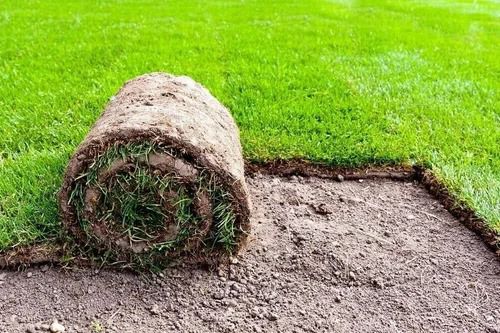
Turf laying (pre-grown sod cut and laid as an instant lawn) gives the fastest result and suits a property being prepared for sale on a short timeline. Cut turf is laid on the prepared soil, rolled for good contact, and watered in immediately — visually presentable within one to two weeks and fully rooted in within four to six weeks. It costs more than runner planting and is less widely available outside the main Kampala-area nurseries, so it’s usually reserved for a property that genuinely needs to look finished fast.
Seeding is rarely used for the warm-season grasses common in Uganda, since most spread better and more reliably from runners or turf. It’s more relevant to cool-season grass varieties that don’t suit Uganda’s climate in the first place, so it’s not a route we typically recommend locally.
Maintaining an Established Lawn in Uganda
An established lawn needs consistent upkeep to keep presenting well. The key tasks:
- Regular mowing — how often depends on growth rate, which is fast for Kikuyu and other warm-season grasses through Uganda’s rainy seasons and slower in the drier spells between. As a rule, mow once the grass reaches 1.5–2x its target height, and never take off more than a third of the blade in one cut — cutting harder than that stresses the grass and causes browning.
- Edging — a clean cut edge along paths, paved areas, and beds gives an otherwise well-mown lawn its finished look. An unedged lawn looks untidy no matter how well the main area is kept.
- Watering — deep, infrequent watering (two to three times a week during the drier stretches) builds deeper root systems that handle Uganda’s dry spells better than shallow, frequent watering does.
- Fertilising — a slow-release lawn fertiliser applied at the start of each rainy season keeps growth vigorous and the colour consistent through the year.
- Weed management — a selective herbicide applied at the first sign of weed encroachment stops broadleaf weeds spreading through an open lawn, which happens quickly in Uganda’s warm, wet conditions if left unchecked.
What Natural Lawn Installation Costs in Uganda
- Site preparation only (clearing, breaking up soil, levelling, topsoil dressing): $0.15–$0.40 per m² depending on how difficult the site is
- Runner planting (grass runner supply and planting, including site preparation): $0.40–$1.20 per m² — the most common and most cost-effective method for Kikuyu and other warm-season grasses in Uganda
- Turf laying (cut turf supply and lay, including site preparation): $1.50–$3.50 per m² depending on availability and distance from the nursery
- Basic manual watering setup (hose reel, sprinkler head, tap connection) for a standard residential compound: $30–$80
- Pop-up irrigation system for a standard residential lawn, where wanted: $200–$600 depending on area and specification — less commonly installed on Ugandan residential compounds than manual watering, but an option for larger or premium properties
As a worked example: a standard residential compound of 300m² planted with Kikuyu runners, including site preparation, typically comes to $150–$450 in total — a modest investment against a property valued anywhere from $65,000 to $250,000 or more, and one that reliably returns several times its cost in buyer perception and avoided price negotiation. Turf laying for the same area, where the faster result justifies the extra cost, typically runs $600–$1,300.
Looking to build or improve your house or rentals?
We offer home construction and improvement services including building, renovation, painting, tiling, plastering, landscaping, kitchen upgrades, and more.
Lawn in the Broader Exterior Improvement Programme
A well-maintained lawn delivers its full value as part of a coordinated exterior presentation across Kampala, Wakiso, and Entebbe. Lawn quality is the foundation of compound presentation, complemented by exterior lighting, boundary definition, compound paving, and any specialist landscaping features. For the fuller exterior picture, see our guides on exterior lighting, landscaping upgrades, and kitchen garden installation.
Getting Lawn and Landscaping Work Done Right
Lawn installation, grass variety selection, site preparation, runner planting, turf laying, and ongoing compound management are all part of the work we carry out for property owners across Kampala, Wakiso, Mukono, and Entebbe, and further afield in Jinja, Mbarara, Mbale, Gulu, and Masaka. We assess each site’s soil, drainage, sun exposure, and expected traffic before recommending a grass variety and installation method — the right choice for a shaded compound in Muyenga is often the wrong one for an open, sun-exposed plot along Entebbe Road, and getting that match right up front saves a lot of frustration later.
For a property being prepared for sale, runner planting or turf laying is one of the fastest, most cost-effective ways to transform a compound’s first impression — and it’s an investment that consistently pays for itself many times over in how a property is perceived the moment a buyer arrives at the gate.
Leave a Reply