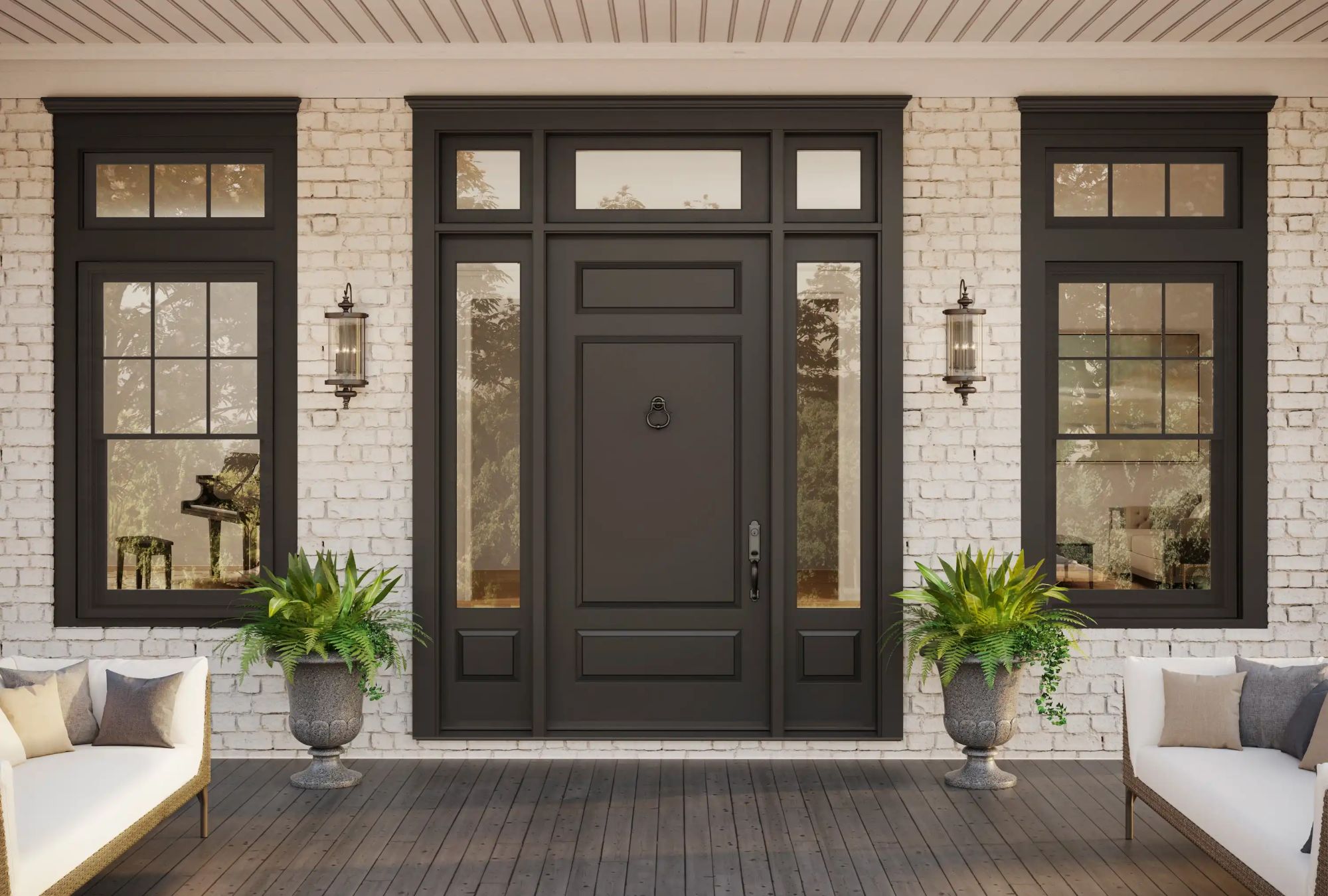
The front door is the first point of physical contact between a buyer and a property anywhere in Kampala, Wakiso, Mukono, or Entebbe. Everything before it — the compound, the approach, the exterior walls — is assessed from a distance. The front door is touched, opened, closed, and judged directly. Its condition, material, security specification, and finish speak immediately to the standard the rest of the property has been kept to. A solid, well-finished, securely fitted door tells a buyer the property has been looked after. A flimsy, warped, poorly fitting, or visually tired door raises the question of what else has been neglected — and in a market as security-conscious as Kampala’s, a weak front door raises that question louder than almost anything else.
This guide, drawn from the door installation work we carry out for property owners across Uganda, looks at the front door as a property investment: what buyers and tenants actually assess, which specifications matter for security and durability in Uganda’s climate, the restore-versus-replace decision, and what quality work costs locally.
Looking to build or improve your house or rentals?
We offer home construction and improvement services including building, renovation, painting, tiling, plastering, landscaping, kitchen upgrades, and more.
What Buyers Actually Assess at the Front Door in Kampala’s Market
Before they step inside, buyers across Kyanja, Ntinda, Kisaasi, or anywhere else in Kampala’s market assess the front door on five dimensions, often without consciously naming any of them. The first is security: does this door look like it would actually resist a break-in attempt? A hollow-core flush door with a single rim latch does not, and in a market where security is one of the first things any prospective buyer or tenant weighs, that failure registers immediately. A solid door with a quality mortice deadlock does. The second is condition: is the door warped, cracked, peeling, or faded from Uganda’s strong equatorial sun and seasonal rains? Any of these signals deferred maintenance. The third is fit: does the door sit squarely in its frame, with no gaps and nothing sticking? A poorly fitting door suggests either an unevenly settled building or a door installed without proper care. The fourth is hardware quality: are the handles, lock, and hinges in good condition and matching? Corroded or mismatched hardware — a common sight on older properties across Kampala and Wakiso — undermines even a genuinely good door. The fifth is visual presentation: does the door’s colour and material suit the rest of the property’s exterior?
These five judgments happen within thirty seconds of a buyer reaching the entrance, and the impression they form there sets the frame of mind they carry into the rest of the viewing. Getting the front door right isn’t a cosmetic decision — it shapes how favourably everything that follows gets judged.
Security Specifications That Matter
Core Type: Solid vs. Hollow
The single most important structural specification for a main entrance door is the core type. Hollow-core flush doors — built with a thin timber or cardboard lattice core and thin facing skins — are lightweight, cheap, and entirely appropriate for internal use where no security function is needed. They’re structurally inadequate for a front entrance: a hollow-core door can be breached with minimal force and offers essentially no resistance to a determined attempt at entry, which is exactly the risk a Kampala-area buyer or tenant is thinking about when they push against the door during a viewing.
Solid-core timber doors — commonly mahogany or the local nkarati timber, both widely available through carpentry workshops across Kampala — give genuine weight and resistance. A solid door of adequate thickness is significantly harder to force and gives a solidity buyers notice even during a brief viewing. Steel-faced doors give the highest level of impact resistance and suit properties where security is the primary concern. Both solid timber and steel-faced doors are appropriate main entrance specifications; hollow-core doors are not, whatever the price difference tempts a seller to think.
Lock Specification
A door’s security is only as good as its lock. A quality mortice deadlock — one whose bolt housing sits recessed into the door body rather than surface-mounted — with a hardened steel bolt gives meaningful resistance to forced entry. The lock needs a reinforced strike plate fixed through the door frame into the structural masonry behind it, not just into surface plaster or a softwood frame casing — a strike plate fixed only into plaster fails under a single kick regardless of how good the lock itself is. Quality mortice deadlocks, widely available through hardware shops around Nakasero and across Kampala, typically cost $25–$70 supplied and fitted, and represent one of the best security investments available on any property.
Frame Fixing and Structural Anchoring
The door frame has to be anchored into the surrounding wall structure, not just the surface plaster finish. Fixing bolts or anchor plates should engage the structural masonry at regular intervals around the frame perimeter. A frame fixed only into plaster pulls away from the wall under sustained force, bypassing the lock entirely — one of the most common installation failures we see on doors fitted by unskilled labour in Kampala and Wakiso, and one of the most important things to check on any door installation, new or existing.
Looking to build or improve your house or rentals?
We offer home construction and improvement services including building, renovation, painting, tiling, plastering, landscaping, kitchen upgrades, and more.
Finish and Weather Resistance in Uganda’s Climate
A front door in Kampala, Wakiso, or Entebbe is exposed to strong equatorial UV, temperature cycling, and Uganda’s two rainy seasons — a combination that degrades poorly protected timber within two to three years. For timber doors, exterior-grade paint or varnish applied over a properly primed surface, with full coverage of the edges and end grain, meaningfully extends the maintenance interval. A door finished with interior-grade paint, or inadequately primed before finishing, will peel, crack, and fade fast once it’s exposed to the elements — a mistake we see often on doors that were finished in a hurry.
Steel doors need less surface maintenance than timber but still have to be properly factory-coated or painted to resist corrosion at cut edges, fixing points, and any scratches — genuinely important given Uganda’s humidity. A powder-coated finish holds up better than liquid-applied paint on a metal door in this climate.
The door’s colour should suit the property’s exterior wall colour. A contrasting accent — a deep navy, forest green, or dark charcoal against a lighter wall — is a simple, low-cost way to make an entrance memorable and photograph well for a listing, which matters in a Kampala market where most viewing requests now start from photos shared online or over WhatsApp.
When to Restore vs. When to Replace
Not every front door needs full replacement before a sale. A solid door that’s structurally sound but visually tired can often be restored at a fraction of replacement cost. Restoration typically means a full strip, sand, re-prime, and repaint with exterior-grade paint; new hardware (handle set, lock cylinder, hinges in a matching finish); and weatherstrip replacement to restore a draught-free, properly sealed fit. Where the door body is sound and properly hung, this typically costs $40–$100 in labour and materials and produces a genuinely significant visual lift.
Replace when: the door is hollow-core and therefore inadequate for a main entrance; it’s warped beyond what re-hanging or hinge adjustment can fix; the timber is badly rotted at the base rail or stiles — a real risk given Uganda’s rain exposure — and structural repair isn’t realistic; or the design is dated enough to visibly drag down the property’s presentation.
What Front Door Work Costs in Uganda
- Front door restoration (strip, repaint, new hardware): $40–$100
- Quality solid timber front door (mahogany or nkarati, standard size, mid-specification finish, quality mortice lock), supplied and installed: $150–$350
- Steel-faced security door, supplied and installed: $200–$450
- Premium solid hardwood or multi-point-locking security door: $400–$800 and up
- Mortice deadlock replacement only (quality lock, supplied and fitted): $25–$70
- Full frame and door replacement including masonry anchoring: add $80–$200 to the door cost above
For a property being prepared for sale anywhere in Kampala, Wakiso, or Entebbe, a front door replacement at $150–$350 — where the existing door is hollow-core, visibly deteriorated, or security-compromised — is among the best-value improvements available. A buyer who feels secure at the entrance carries that confidence through the rest of the viewing. One who doesn’t will price the property accordingly.
Looking to build or improve your house or rentals?
We offer home construction and improvement services including building, renovation, painting, tiling, plastering, landscaping, kitchen upgrades, and more.
The Front Door in the Broader Exterior Presentation
A front door has the most impact when it’s part of a coherent, well-presented entrance overall. A quality door set against a clean path, functioning exterior lighting, and a freshly painted perimeter wall creates an arrival experience that reads as consistent, not patched together. See our guides on exterior lighting, repairing rotten doors and windows, and lawn and compound presentation for the fuller exterior picture.
Getting Door Installation Done Right
Front door supply, installation, frame fixing, lock fitting, and finishing are all work we carry out regularly for property owners across Kampala, Wakiso, Mukono, and Entebbe, and further afield in Jinja, Mbarara, Mbale, Gulu, and Masaka. Every installation is checked for correct frame anchoring, lock specification, and fit before we consider the job done — a door that looks right but isn’t properly anchored gives a false sense of security that fails exactly when it matters. You can see a recent example in our front door installation project in Kawempe, Kampala.
For a property going on the market, the front door is one of the most visible and highest-impact improvements available, and in most cases one of the most affordable relative to what it does for a buyer’s first impression.
Leave a Reply