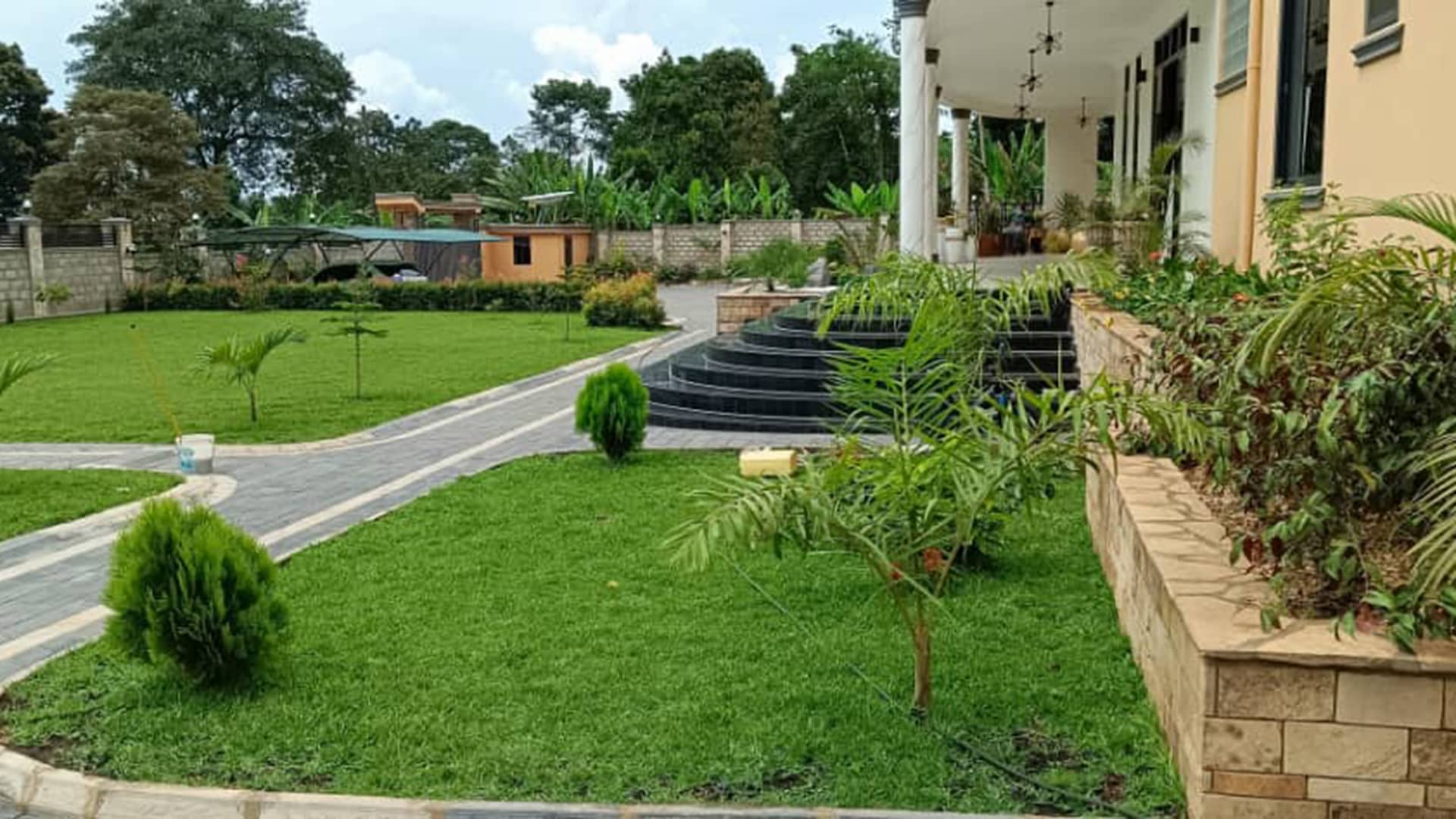
Landscaping materials in Kampala cost roughly UGX 35,000 to UGX 70,000 per square metre for installed interlocking pavers, UGX 30,000 to UGX 50,000 per square metre for concrete parking tiles, UGX 4,000 to UGX 9,000 per square metre for natural carpet grass planted on prepared ground, and UGX 12,000 to UGX 25,000 per metre for concrete kerbstones, while natural stone paving starts around UGX 60,000 per square metre. A well-designed compound in Uganda combines hard landscaping (pavers, kerbs, stone and parking areas) with soft landscaping (grass, flowers, shrubs, trees, fruit trees and vegetables) so that the whole property looks finished, drains properly and is easy to maintain.
Compound landscaping is one of our home improvement services. We design and install pavers, kerbstones, natural stone, concrete parking tiles, natural carpet grass, flower beds, hedges, trees, fruit and vegetable gardens for homes, rentals and commercial properties in Kampala, Wakiso, Mukono, Entebbe and across Uganda. Every compound is different, so we set the exact price after we visit your site, measure the area in square metres and assess the slope, soil and drainage. In this full guide you will learn which landscaping materials to choose, what each costs, which plants grow best around Kampala, how to design a compound layout step by step, and how a good compound raises both property value and rental income. Keep reading.
All prices below are approximate 2026 planning ranges built from supplier price lists and typical installation rates in Uganda, and every area price is per square metre. Brand, thickness, ground condition, access for trucks and location move them up or down, so treat them as a guide and not as a final quotation. The surest way to get a firm figure is a site visit.
Looking to build or improve your house or rentals?
We offer home construction and improvement services including building, renovation, painting, tiling, plastering, landscaping, kitchen upgrades, and more.
Landscaping Materials in Kampala at a Glance
This table gives the short answer on the main landscaping materials used in Ugandan compounds. Each one is explained in detail later in the guide.
| Material | Best Used For | Approx. Installed Price (UGX) |
|---|---|---|
| Interlocking concrete pavers | Driveways, walkways, patios, compound floors | 35,000 to 70,000 per square metre |
| Concrete parking tiles | Parking bays, car ports and grass-gap driveways | 30,000 to 50,000 per square metre |
| Kerbstones (cabstones) | Edging paving, flower beds and driveways | 12,000 to 25,000 per metre |
| Natural stone paving | Premium paths, patios, feature areas | 60,000 to 120,000 per square metre |
| Natural carpet grass | Lawns and open compound areas | 4,000 to 9,000 per square metre |
| Decorative pebbles and gravel | Garden borders, drainage strips, feature beds | 25,000 to 60,000 per square metre |
| Retaining stone walls | Sloping compounds and raised beds | 80,000 to 150,000 per square metre of wall face |
| Flowers and shrubs | Colour, borders and hedges | 3,000 to 50,000 per plant |
| Ornamental and shade trees | Shade, privacy and compound character | 5,000 to 150,000 per tree |
| Fruit trees and vegetables | Food, shade and productive compounds | 3,000 to 60,000 per seedling |
What Is Landscaping and Compound Design in Uganda?
Landscaping, also called compound design, is the planned arrangement of everything outside your house: the driveway, parking, paths, lawn, flower beds, trees, boundary edges, drainage and lighting. In many Ugandan compounds these areas are left as bare red soil, patchy grass or cracked concrete, which turns to mud in the rainy season and dust in the dry season. Good landscaping solves those problems and makes the property look finished.
Landscaping has two parts that work together:
- Hard landscaping is everything made of solid material: pavers, parking tiles, kerbstones, natural stone, retaining walls, steps and drainage channels.
- Soft landscaping is everything living: natural carpet grass, flowers, shrubs, hedges, trees, fruit trees and vegetables.
The best compounds balance both. Too much hard surface makes a property hot, bare and prone to runoff. Too much soft surface turns muddy near the entrance and where cars park. The skill is in putting each material where it works best, and that is what the rest of this guide explains.
Pavers in Kampala: Types, Prices and Installation
Interlocking concrete pavers, often called cabro in Uganda, are the most popular hard landscaping material for compounds. They are small concrete blocks that lock together in a pattern over a compacted base. They handle vehicle weight, drain water through the joints, can be lifted and relaid if a pipe needs repair, and look neat for many years when installed correctly.
Types of Pavers
| Paver Type | Thickness | Typical Use |
|---|---|---|
| Standard I-shape or zigzag pavers | 60 mm | Walkways, patios and light-traffic compound areas |
| Heavy-duty pavers | 80 mm | Driveways and parking areas |
| Colour pavers (red, grey, brown, charcoal) | 60 to 80 mm | Patterns, borders and decorative layouts |
| Premium and designer pavers | 60 to 80 mm | Entrances, feature areas and high-end homes |
| Grass pavers | 80 mm | Parking areas that stay partly green |
Paver Prices in Kampala
Installed pavers generally cost about UGX 35,000 to UGX 70,000 per square metre, covering the pavers, the compacted base, bedding sand, edge restraint, joint sand and labour. Standard 60 mm pavers for walkways sit near the lower end, while 80 mm heavy-duty and premium designer pavers sit near the top. Ground preparation, such as excavation, levelling on a slope and hauling away soil, can add to the cost.
Estimated Paving Cost by Area
| Paved Area | Standard Pavers (UGX) | Heavy-Duty or Premium Pavers (UGX) |
|---|---|---|
| 50 square metres | 1.8M to 2.8M | 2.8M to 3.5M |
| 100 square metres | 3.5M to 5.5M | 5.5M to 7M |
| 200 square metres | 7M to 11M | 11M to 14M |
| 300 square metres | 10.5M to 16.5M | 16.5M to 21M |
| 500 square metres | 17.5M to 27.5M | 27.5M to 35M |
How Pavers Are Installed Properly
- Site visit and setting out. We measure the area, mark levels and plan falls so water runs away from the house and not toward it.
- Excavation. Topsoil and soft ground are removed to the required depth.
- Sub-base. Crushed stone or hardcore is laid in layers and compacted with a plate compactor. A weak base is the number one reason paving sinks.
- Edge restraint. Kerbstones or concrete edging are fixed around the area so the pavers cannot spread.
- Bedding layer. A thin, level layer of sand is screeded to a precise thickness.
- Laying. Pavers are laid in the chosen pattern, with cut pieces fitted neatly at the edges.
- Compaction and joint sand. The surface is compacted, fine sand is swept into the joints, and the surface is compacted again so the pavers lock together.
See a real installation in our premium pavers installation project in Kampala.
Popular Paver Patterns
The herringbone pattern is the strongest for driveways because it spreads vehicle load in several directions. Stretcher bond and basket weave suit patios and walkways. Mixing two colours in borders, circles or bands turns a plain driveway into a feature. A simple rule is to use one main colour for the field, one contrast colour for the border and keep the pattern consistent across the compound.
Looking to build or improve your house or rentals?
We offer home construction and improvement services including building, renovation, painting, tiling, plastering, landscaping, kitchen upgrades, and more.
Concrete Parking Tiles in Uganda: Cost and Where to Use Them
Concrete parking tiles are larger, thicker concrete slabs made for vehicle areas. Many have open grass gaps so that grass grows between the tiles, which keeps the driveway cooler, lets rain soak into the ground and reduces runoff. Others are solid and laid tight like heavy paving. Both give a clean, firm surface for parking that stays firm in the rainy season when bare soil turns to mud.
Where Parking Tiles Work Best
- Home parking bays beside the house or under a car port.
- Driveway wheel tracks with grass in the middle strip, a classic and economical look.
- Rental and apartment parking where many cars use the area daily.
- Commercial yards and office compounds that need a strong, low-maintenance surface.
Installed concrete parking tiles typically cost about UGX 30,000 to UGX 50,000 per square metre, depending on thickness, design and base preparation. Like pavers, the strength of the finished area comes mostly from the compacted base underneath, not the tile on top. Read about the work we do in our premium concrete parking tiles installation project.
Pavers or Parking Tiles: Which Should You Choose?
| Feature | Interlocking Pavers | Concrete Parking Tiles |
|---|---|---|
| Look | Patterned, colourful and decorative | Clean, simple and robust |
| Best for | Whole compounds, walkways and patios | Parking bays and driveway tracks |
| Grass option | Possible with grass pavers | Common with open grass gaps |
| Water drainage | Through the joints | Through the joints and grass gaps |
| Design flexibility | Very high | Moderate |
Many compounds use both: pavers for paths, patios and the entrance, and parking tiles for the vehicle area. We help you decide the right mix during the site visit.
Kerbstones (Cabstones) in Kampala: Edging That Holds Everything Together
Many people search for cabstones when they mean kerbstones, the long concrete edging blocks that frame driveways, paths and flower beds. Kerbstones do more than look neat: they stop pavers from spreading sideways, separate grass from paving, keep soil and mulch inside beds and give the compound crisp lines. A paved area without proper edging slowly loosens at the sides, so edging is not optional.
- Straight kerbs for driveways, paths and the edge of lawns.
- Curved or flexible kerbs for round flower beds and tree rings.
- Raised kerbs for planters and bed borders.
- Flush edging that sits level with the ground so lawn mowers pass easily.
Installed kerbstones usually cost about UGX 12,000 to UGX 25,000 per metre, bedded in concrete for a firm hold. Always budget for edging when you budget for paving.
Natural Stone for Compounds in Uganda: Paving, Walls and Features
Natural stone gives a compound a premium, timeless look that concrete cannot fully copy. Each stone is different in colour and texture, and natural stone ages gracefully. It costs more than concrete, so many homeowners use it for feature areas such as entrance steps, patios, garden paths, stepping stones and retaining walls, and use pavers or tiles for the larger areas.
Common Natural Stone Options
| Stone | Look | Typical Use |
|---|---|---|
| Granite slabs and setts | Hard, dense, grey to dark tones | Driveways, entrances and steps |
| Quarry stone | Rough, earthy and natural | Garden paths, boundary and retaining walls |
| Flagstone and slate-type slabs | Flat, irregular, layered | Patios, stepping stones and borders |
| River pebbles and cobbles | Smooth and rounded | Drainage strips, bed borders and water features |
| Crushed stone and gravel | Fine and neutral | Paths, parking and low-cost cover |
Natural stone paving costs about UGX 60,000 to UGX 120,000 per square metre installed, depending on the stone, thickness and finish. Retaining walls built from stone are priced by wall face area and usually run about UGX 80,000 to UGX 150,000 per square metre, and they are especially valuable in Kampala’s many hillside compounds where soil needs to be held back. If you want stone at home as well, see our guide to the price of tiles and the cost of tiling work in Uganda for stone-look and granite options inside the house.
Looking to build or improve your house or rentals?
We offer home construction and improvement services including building, renovation, painting, tiling, plastering, landscaping, kitchen upgrades, and more.
Natural Carpet Grass in Uganda: Lawns That Last
Natural carpet grass is the most popular lawn grass in Uganda. It spreads low and thick, forms a soft, even green carpet, tolerates foot traffic and grows well in Kampala’s warm, humid climate. It is also the most affordable way to turn a bare compound green. A lawn cools the surroundings, reduces dust and mud, and makes even a modest house look cared for.
Why Choose Natural Carpet Grass
- Affordable. It is one of the cheapest landscaping materials per square metre.
- Dense and soft. It forms a thick surface that crowds out weeds once established.
- Cooling. A green lawn lowers the heat around the house.
- Controls dust and erosion. Roots hold the soil during heavy rain.
- Easy to maintain. It needs regular watering during dry spells and trimming, but no complicated care.
How Carpet Grass Is Planted
- Clear and level the ground. Weeds, stones, roots and rubbish are removed, and the surface is graded so water does not pond.
- Add topsoil. A layer of good topsoil, with compost or manure where needed, gives the grass a fertile base.
- Plant the grass. Grass is laid or planted in pieces close together so it spreads quickly into a full cover.
- Press and water. The surface is pressed down for contact with the soil and watered thoroughly.
- Establish. Regular watering for the first weeks helps roots take hold, after which the lawn thickens and needs less attention.
Natural carpet grass planted on prepared ground generally costs about UGX 4,000 to UGX 9,000 per square metre, depending on the amount of topsoil, levelling and the size of the lawn. Learn more about our lawn work on our natural carpet grass planting and supply page.
Natural Grass or Artificial Grass?
Artificial grass needs no watering or cutting and stays green all year, but it costs far more per square metre, heats up in strong sun and does not cool the compound the way living grass does. Natural carpet grass costs much less and improves the environment around the house, while needing regular care. For most family compounds natural grass gives the best value, and artificial grass suits small patios or shaded areas where grass struggles.
Best Flowers and Ornamental Plants for Compounds in Uganda
Flowers and ornamental plants bring colour, scent and life to a compound. Uganda’s warm climate and two rainy seasons suit a wide range of flowering plants, and the best compounds choose plants that match the sun, the soil and the amount of care the owner can give. Planting in groups of three or five of the same plant looks far better than a single plant of many types.
| Plant | Why It Works | Best Position |
|---|---|---|
| Bougainvillea | Bright colour, tough in heat and dry spells | Boundary walls, gates and sunny corners |
| Hibiscus | Large flowers all year in many colours | Borders and hedges in full sun |
| Ixora | Clusters of red, orange or yellow flowers, compact shape | Front beds and low borders |
| Frangipani | Fragrant flowers, sculptural shape | Entrances and feature corners |
| Canna lily | Bold leaves and flowers, grows fast | Back of flower beds and wet corners |
| Duranta | Fast-growing, clips well as a hedge | Boundary hedges and screens |
| Lantana | Hardy, colourful, attracts butterflies | Sunny beds and slopes |
| Euphorbia (crown of thorns) | Very low water needs | Dry beds and pots |
| Agapanthus | Blue or white flower heads, neat clumps | Borders and path edges |
| Roses and geraniums | Classic garden flowers in pots and beds | Patios and entrances |
| Ferns, spider plants and peace lilies | Lush green in shade | Shaded verandas and north-side beds |
Flowers and shrubs usually cost between UGX 3,000 for small seedlings and UGX 50,000 or more for mature, container-grown specimens. A good planting plan uses a few larger plants for structure and many smaller ones to fill gaps, which keeps the cost reasonable while the garden grows.
Hedges and Privacy Screens
Hedges soften boundary walls, give privacy and cut dust and noise from the road. Duranta, hibiscus, thuja and bamboo-type hedges are common choices. Keep plants a safe distance from walls, drains and underground pipes, because strong roots can damage them over the years.
Palms and Feature Plants
Palms such as fan palms, royal palms and cycads give a compound a tropical, high-end look and need little maintenance once established. Place them where they have room to grow, because a palm planted too close to a wall or gate quickly outgrows its place. Pots and raised planters work well on patios and verandas where there is no soil.
Looking to build or improve your house or rentals?
We offer home construction and improvement services including building, renovation, painting, tiling, plastering, landscaping, kitchen upgrades, and more.
Best Trees to Plant in a Compound in Uganda
Trees are the longest-lasting investment in any compound. They give shade that cools the house, shelter from wind, privacy from neighbours and a strong, mature look that adds real character. The most important rule is to choose the right tree for the right place, because the wrong tree in the wrong place causes years of trouble.
Choosing the Right Tree
- Mind the roots. Plant large trees well away from the house, drains, septic tanks, boundary walls and paved areas. Roots of big trees can crack foundations and lift paving.
- Mind the final size. A small seedling becomes a large tree. Check the mature height and spread before planting.
- Mind the litter. Trees that drop heavy fruit, pods or leaves near parking areas make cleaning constant.
- Use shade where you need it. A tree on the west side of the house cuts the afternoon heat, and shade over a seating area makes the compound usable.
| Tree | Best For | Notes |
|---|---|---|
| Jacaranda | Spring-flowering shade tree for larger compounds | Spectacular purple flowers, needs space |
| Mango | Shade and fruit in large compounds | Big canopy, keep away from the house |
| Avocado | Shade and fruit | Fast growing, needs room |
| Cypress and thuja | Privacy screens and formal entrances | Tall, narrow shapes suit tight spaces |
| Fan palm and royal palm | Entrance and feature planting | Little shade, high visual impact |
| Bottlebrush and flame trees | Flowering shade for medium compounds | Bright seasonal flowers |
| Neem and shade trees | Hardy shade for larger plots | Strong, drought-tolerant |
Tree prices vary a lot with size, from about UGX 5,000 for a small seedling to UGX 150,000 or more for a large, established tree delivered and planted. For small Kampala plots, choose compact trees and keep large species for bigger compounds in Wakiso, Mukono and upcountry.
Fruit Trees and Vegetable Gardens for Compounds in Uganda
A productive compound combines beauty with food. Fruit trees give shade, a pleasant look and free fruit, and a small vegetable garden saves money on the table every week. This is especially popular with families in Wakiso, Mukono, Entebbe and upcountry, and it is a clear selling point for buyers who want a home with some food growing at the gate.
Fruit Trees That Grow Well in Uganda
| Fruit | Notes |
|---|---|
| Mango (grafted) | Fruits earlier than seedlings, needs plenty of space |
| Avocado (grafted) | Popular and valuable, needs good drainage |
| Oranges, lemons and tangerines | Suit medium compounds, fruit well with regular watering |
| Passion fruit | Climber, good on fences and trellises |
| Guava | Hardy and productive, easy to grow |
| Pawpaw | Fast growing, fruits within a year |
| Jackfruit | Large tree for big compounds |
| Bananas | Grow in groups and work well near drainage points |
| Pomegranate and tree tomato | Compact options for small plots |
Always choose grafted or improved seedlings from a reputable nursery for faster fruiting and better quality. Fruit seedlings generally cost from about UGX 3,000 to UGX 60,000 depending on type and size.
A Simple Kitchen Garden
Even a few square metres can grow useful vegetables. Common choices include sukuma wiki (kale), spinach, dodo (amaranth), tomatoes, onions, green pepper, eggplant, cabbage, carrots and herbs such as coriander, mint, rosemary and basil. A raised bed filled with good soil drains well and keeps the garden tidy. Place it near a water point and in a sunny spot, and keep it close to the kitchen so it actually gets used.
How to Design a Compound Layout in Uganda: Step by Step
Good compound design starts on paper, not with materials. A planned layout costs less than a compound built piece by piece, because areas, levels and drainage all work together. Here is the order we follow.
- Measure the compound. We record boundaries, the house footprint, gates, trees, slopes and anything that cannot move.
- Plan how people and cars move. The driveway, parking, front path and back path come first, because they carry daily traffic.
- Plan drainage. Water must run away from the house to a drain, soak-away or garden, never into the foundation.
- Zone the compound. Entrance and parking at the front, a seating or play area to one side, a garden or kitchen garden at the back.
- Choose hard materials. Pavers, parking tiles, kerbs and stone go where traffic and wear are heaviest.
- Choose soft landscaping. Lawn, beds, hedges and trees fill the remaining space with sensible spacing.
- Add lighting and finishing touches. Lights, pots, benches and gate details complete the look.
Compound Design Ideas by Plot Size
| Compound Size | Layout Idea |
|---|---|
| Small plots such as 50x100ft | Paved parking and path, narrow beds along the wall, climbing plants and a small lawn strip |
| Medium plots | Paved driveway, lawn, a feature bed at the entrance and two or three trees |
| Large plots and half acres | Long driveway, large lawn, flower beds, fruit trees, a kitchen garden and a seating area |
| Rentals and apartment blocks | Durable parking tiles, low-maintenance planting, clear walkways and good lighting |
For the plot sizes and prices behind these layouts, see our guide on the price of a 50x100ft plot in Kampala.
Drainage: The Part Most People Forget
Kampala gets heavy rain, and water that has nowhere to go ends up under the house, in the parking area or on the neighbour’s land. Good landscaping shapes the ground so that water runs along a gentle fall to a drain, a soak-away or a planted area. Paved areas are laid with a slight slope, gravel strips take water along walls, and lawn and beds absorb water in the open spaces. A compound without drainage planning looks good in the dry season and fails in the first heavy rain.
Looking to build or improve your house or rentals?
We offer home construction and improvement services including building, renovation, painting, tiling, plastering, landscaping, kitchen upgrades, and more.
Outdoor Living Spaces, Lighting and Finishing Touches
Once the main surfaces and planting are in place, small additions make the compound a place people actually use. A paved patio with a seating area, a shaded corner under a tree, a barbecue spot, a children’s play area or a quiet garden bench turn unused ground into living space. Pots, planters and trellises add height and colour in small spaces.
Lighting matters just as much. Path lights, gate lights and uplights on trees make a compound safer after dark, show off the landscaping in the evening and discourage intruders. Solar lights are popular because they cost little to run. For more on this, read our guide on how exterior lighting can boost your home’s value, and see how a new gate completes a compound in our main gate installation project in Entebbe.
Landscaping Sloping Compounds in Kampala: Steps, Terraces and Retaining Walls
Kampala is built on hills, and many plots slope from the road down to the back or from one side to the other. A slope is not a problem if it is designed for: it can become terraces, planted banks and steps that give a compound real character. Left alone, however, a slope sheds soil in every heavy rain, dumps mud onto paving and undermines the house.
- Retaining walls hold soil back and create flat terraces. They are built from natural stone, concrete blocks or poured concrete, with drainage behind them so water does not build up pressure.
- Steps in stone, concrete or paving link levels safely. Even, comfortable steps with a gentle rise are far safer than steep ones, especially in the rain.
- Terraced beds turn steep ground into planting space for flowers, shrubs or vegetables.
- Planted banks use deep-rooted grass and ground cover to hold gentle slopes in place.
- Drainage channels carry runoff across or down the slope without washing out beds and paving.
Slope work should always be planned on site, because the right solution depends on the angle, the soil and where water flows. This is a main reason we insist on a site visit before pricing a compound. A hillside plot with good terracing and steps usually looks far more valuable than a flat plot left bare.
Compound Walls, Fences and Gates: Framing Your Landscaping
The boundary is the frame around everything inside it. A freshly landscaped compound inside a cracked, faded wall loses much of its impact, so boundary walls, fences and gates belong in the plan. Painted walls in a colour that matches the house, a smart gate with matching pillars and a planted strip along the inside of the wall tie the whole property together. Climbers such as bougainvillea and passion fruit soften a plain wall and add privacy.
Security matters too. Good lighting along walls and at the gate, clear sight lines from the house to the entrance and strong gates make a compound safer. For the finishing touch, see how we install gates in our main gate installation project in Entebbe, and how fresh paint transforms boundary walls in our guide to house paint colours and designs in Uganda.
Looking to build or improve your house or rentals?
We offer home construction and improvement services including building, renovation, painting, tiling, plastering, landscaping, kitchen upgrades, and more.
Compound Landscaping Styles That Work in Uganda
Choosing a style first keeps the materials, plants and colours consistent. These are the styles our clients ask for most.
| Style | Key Features | Best For |
|---|---|---|
| Modern and clean | Straight lines, grey or charcoal pavers, flush kerbs, neat lawn, palms and a few bold shrubs | New contemporary homes and apartments |
| Tropical garden | Palms, canna, frangipani, ferns, curved beds, pebbles and stepping stones | Homes with space and shade |
| Family and productive | Large lawn, fruit trees, kitchen garden, shaded seating and play area | Family homes in Wakiso, Mukono and Entebbe |
| Low maintenance | Parking tiles and pavers, gravel strips, hardy shrubs, minimal lawn | Rentals, busy owners and commercial compounds |
| Classic and formal | Symmetrical layout, clipped hedges, a central feature and natural stone details | Large, high-end properties |
Decorative Features: Pebbles, Water, Planters and Garden Art
Small features lift a compound from tidy to memorable. River pebbles and decorative gravel around plants and along walls give a clean finish and keep soil from splashing onto walls. Raised planters and large pots add height on patios and near entrances. A small water feature or birdbath brings sound and wildlife, and stepping stones across a lawn guide people along the route you want. Keep these touches few and well placed; one or two good features look far better than many scattered ones.
Ready to turn ideas like these into a plan for your own compound? Message us on WhatsApp and we will arrange a site visit.
How Much Does Landscaping Cost in Uganda? Budget Examples Per Square Metre
Because every compound has a different mix of paving, grass and planting, the fairest way to budget is by area. The table below shows how a total budget builds up for three common compound styles. The figures are planning ranges for the full compound, using the per-square-metre rates earlier in this guide, and the exact price depends on what we find on site.
| Compound Style | What It Includes | Approx. Budget (UGX) |
|---|---|---|
| Basic compound | 100 square metres of standard pavers, kerb edging, 150 square metres of carpet grass, a few shrubs | 5M to 8M |
| Standard family compound | 200 square metres of pavers or parking tiles, kerbs, 300 square metres of lawn, flower beds, hedge and several trees | 11M to 18M |
| Premium compound | 300 square metres of premium pavers with stone features, retaining walls, large lawn, mature trees, planting and lighting | 22M to 40M and above |
You do not have to do everything at once. Many clients start with the driveway, parking and drainage, which solve the most urgent problems, and add the lawn, planting and features over the next seasons. A phased plan, drawn up at the start, means each stage fits the next.
What Makes a Landscaping Quotation Higher or Lower
- Ground condition. Soft soil, swampy ground and rock all change the amount of excavation and base material.
- Slope. Hillside compounds need levelling, steps and retaining walls, which adds cost but also adds value.
- Material quality. Paver strength, stone type and plant size all change the price.
- Access. If trucks cannot reach the site, materials are carried in by hand and cost more to move.
- Size of the job. Larger areas cost less per square metre because setup and transport are shared.
- Design detail. Patterns, curves, steps and feature areas take more time than a simple rectangle.
- Location. Materials and labour cost more for sites far from Kampala’s supply points.
Landscaping is also part of the wider cost of finishing a home. See how it fits into the bigger picture in our guide on how much it costs to build a residential house in Uganda.
Soil, Topsoil, Mulch and Irrigation: The Foundations of a Healthy Garden
Plants are only as good as the soil they stand in. Many new compounds in Kampala sit on hard, compacted or stony subsoil left behind after construction, and planting directly into it gives weak, slow-growing plants. Putting the right foundation under the garden saves money and heartache later.
- Topsoil. A layer of good, dark topsoil gives lawns and beds a fertile start. Beds should have at least 20 to 30 centimetres of good soil, and lawns at least 10 to 15 centimetres.
- Compost and manure. Mixing in well-rotted compost or manure improves poor soil and holds moisture through the dry months.
- Mulch. A layer of dried grass, wood chips or leaves on beds keeps moisture in, stops weeds and protects roots from the sun.
- Irrigation. Simple hose points, drip lines for beds and sprinklers for lawns make dry-season care easy. Planning water points early avoids digging up new paving later.
- Rainwater harvesting. A tank that collects roof water gives free water for the garden through the dry spells.
How Landscaping Can Increase Home Value in Uganda
The outside of a house is the first thing a buyer sees, and it shapes their opinion before they step through the door. A bare, muddy or cracked compound makes a good house feel unfinished, while a neat driveway, a green lawn and well-placed planting make the same house feel complete. Landscaping is one of the most visible upgrades you can make, and it often returns more in perceived value than it costs.
- Curb appeal. A good entrance and driveway lift the whole property in photos and viewings.
- Usable space. Patios, seating areas and gardens add living space without adding rooms.
- Parking and access. A firm, level parking area is a real selling point in Kampala, where parking is scarce.
- Protection of the house. Good drainage, paved edges and stable ground protect walls and foundations from water damage.
- Cooler surroundings. Trees and lawns reduce heat, which buyers and tenants notice.
- Faster sales. A well-presented property attracts more viewers and sells with fewer price cuts.
If you plan to sell, focus first on the entrance, the driveway and the lawn, then clean up beds and hedges. Read more in our guides on how landscaping upgrades increase home value and how outdoor living space attracts buyers.
How Landscaping Can Increase Rental Income in Uganda
For landlords, the compound is part of what a tenant pays for. Secure, tidy parking, clean paths, good lighting and neat greenery make a rental feel safer and more valuable than a similar unit with a dusty or muddy yard. Tenants who feel proud of where they live stay longer and look after the property better.
- Higher rent. Rentals with paved parking and a neat compound support higher monthly rents than comparable units without them.
- Shorter vacancy. Attractive compounds photograph well and draw more enquiries.
- Lower maintenance. Pavers, parking tiles and low-maintenance planting cost far less to keep than mud, dust and patchy grass.
- Better tenants. Quality surroundings attract tenants who pay on time and care for the property.
- Safety. Lit paths and clear walkways reduce accidents and improve security.
For rentals, we recommend durable parking tiles for vehicle areas, strong paved walkways, easy-care planting such as hardy shrubs and hedges, and solid lighting at entrances and parking. Read our guide on smart investments for higher rental income and better tenants for more ways to raise returns.
Looking to build or improve your house or rentals?
We offer home construction and improvement services including building, renovation, painting, tiling, plastering, landscaping, kitchen upgrades, and more.
Common Landscaping Mistakes to Avoid in Uganda
- Skipping the base under paving. Pavers laid on weak or uncompacted ground sink and ripple within a season.
- Ignoring drainage. Water pushed toward the house causes damp, and water pushed toward the neighbour causes disputes.
- No edging. Pavers without kerbs spread and loosen at the edges.
- Planting big trees too close to the house. Roots and branches damage foundations, walls, gutters and roofs.
- Planting directly into poor subsoil. Plants stay weak without good topsoil.
- Overpaving. Too much hard surface makes a compound hot and increases runoff. Leave room for grass and planting.
- Forgetting water points and lighting. Adding pipes and cables later means digging up finished work.
- Choosing plants without thinking of upkeep. A high-maintenance garden dies quickly when it is not cared for.
- Buying on price alone. The cheapest quotation often skips base preparation, and the work fails within a year.
How to Maintain Pavers, Lawns and Gardens in Uganda
Maintaining Pavers and Parking Tiles
Sweep paving regularly and wash it with water and a stiff brush. Pull weeds from joints early, top up joint sand when it washes out, and clean oil stains quickly. Pavers that settle can be lifted and relaid, which is one of their best advantages.
Maintaining Natural Carpet Grass
Water the lawn well during dry spells, preferably early morning or evening. Trim it regularly so it stays thick, remove weeds before they spread, and top-dress bare patches with soil and fresh grass. A little fertiliser at the start of the rains keeps it green.
Maintaining Flowers, Hedges and Trees
Prune hedges and shrubs after flowering, remove dead branches, mulch beds and water young plants deeply and less often, so roots grow downward. Trim tree branches away from roofs, wires and gutters before the rains.
A Seasonal Care Calendar
| Season | What to Do |
|---|---|
| Start of the rains | Plant trees, shrubs and grass, add compost and fertiliser, and check drainage lines |
| During the rains | Weed regularly, clear drains and check paving for washed-out joint sand |
| End of the rains | Prune hedges, mulch beds and repair low spots |
| Dry season | Water early or late, keep mulch in place and trim lawns often |
How to Choose a Landscaping Company in Uganda
- Ask to see completed work and look at paving that has been in use for a while, not just fresh photos.
- Insist on a site visit. A contractor who prices from a message has not seen your slope, soil or drainage.
- Check the specification. The quotation should state the paver thickness, base depth, edging and plant sizes.
- Compare by square metre. It lets you compare quotations fairly.
- Agree on stages and payments. Clear stages avoid disputes.
- Ask about aftercare. A good company explains how to look after the finished work.
How Our Landscaping Service Works: From Site Visit to Handover
- You contact us on WhatsApp, by phone or by email and tell us where the property is.
- We visit your site, measure every area in square metres and assess the ground, slope and drainage.
- You receive a clear written quotation and a simple layout plan showing paving, lawn, planting and drainage.
- We source the materials, through our hardware store in Nakasero, Kampala and our partner suppliers across Uganda.
- Our team builds the compound in stages, starting with levels and drainage, then hard landscaping, then planting.
- We walk through the finished work with you and explain how to care for it.
Landscaping Services Across Kampala, Wakiso, Mukono, Entebbe and All of Uganda
We work in Kampala areas such as Kyanja, Ntinda, Kololo, Muyenga, Makindye, Najjera, Kira, Bukoto, Naguru and Nakasero, and in Wakiso, Entebbe, Gayaza, Namugongo, Seguku, Kitende, Mukono, Mpigi and Jinja, and upcountry across Uganda. Wherever you are, the process is the same: a site visit, a measured written quotation and a proper job from the base to the final plant.
See our landscaping work in detail: premium pavers installation in Kampala, natural carpet grass planting in Uganda and concrete parking tiles installation. For a fresh exterior to match your new compound, read our guide to the best house paint colours and designs in Uganda.
Looking to build or improve your house or rentals?
We offer home construction and improvement services including building, renovation, painting, tiling, plastering, landscaping, kitchen upgrades, and more.
Frequently Asked Questions About Landscaping in Uganda
How much do pavers cost in Kampala?
Installed pavers cost roughly UGX 35,000 to UGX 70,000 per square metre, depending on thickness, design and ground preparation. The exact price is set after a site visit.
What is the difference between pavers and concrete parking tiles?
Pavers are smaller interlocking blocks used for patterned driveways, paths and patios. Parking tiles are larger, thicker slabs, often with grass gaps, made for vehicle areas.
What are cabstones and what are they used for?
Cabstones, properly called kerbstones, are concrete edging blocks that hold paving in place and separate paving from lawns and flower beds.
How much does natural carpet grass cost per square metre?
Planted on prepared ground, it usually costs about UGX 4,000 to UGX 9,000 per square metre, depending on levelling and topsoil.
Which flowers grow best in Kampala?
Bougainvillea, hibiscus, ixora, frangipani, canna lilies, lantana and duranta all do well in Kampala’s climate with sensible care.
Which trees should I avoid planting near the house?
Large, wide-rooted trees such as mango, avocado and big shade trees should be planted well away from foundations, drains, septic tanks and paving.
Can I grow fruit and vegetables in a small compound?
Yes. Compact fruit trees, passion fruit on fences and a raised vegetable bed near the kitchen work even in small plots.
Do you work outside Kampala?
Yes. We work in Kampala, Wakiso, Mukono, Entebbe and across Uganda.
Does landscaping really increase property value?
Yes. A neat driveway, a green lawn, good drainage and tidy planting improve first impressions, support a higher price and help the property sell or rent faster.
Final Thoughts: Landscaping Materials and Compound Design in Uganda
A great compound is planned, not improvised. It starts with levels and drainage, uses the right hard materials where traffic is heaviest, fills the rest with healthy lawn, flowers, hedges, trees and food plants, and ends with lighting and finishing touches. Whether you want a home that looks beautiful, sells for more or rents faster, the compound is where it starts. Tell us about your property and we will visit, measure and give you a clear price.
Leave a Reply