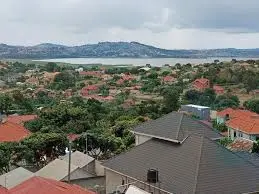
Fifteen kilometres south of Kampala’s city centre, where Entebbe Road begins its long descent toward the airport and the lake, lies one of Greater Kampala’s most quietly consequential real estate corridors. Kawuku — a broad lakeside community straddling Wakiso District — has spent the last decade absorbing overflow demand from a congested capital while quietly building its own identity as a serious residential, commercial, and investment destination.
Unlike Munyonyo or Buziga, which have already transitioned into established premium addresses with prices to match, Kawuku remains in that productive middle phase where land values are rising but entry points have not yet closed to investors of moderate means. The community is divided into distinct sub-areas — Bwerenga, Bugiri, and Bukasa — each with its own character, price tier, and investment logic. Understanding the difference between these three zones is the first step to making a well-positioned decision in this market.
This guide, produced by Mbogo Real Estate Core International, examines each sub-area in depth, explains the infrastructure trends shaping the entire corridor, and offers practical guidance for buyers, developers, and investors approaching the Kawuku market in 2024 and beyond.
Looking For Our Services?
Choose your option below:
Understanding Kawuku: The Bigger Picture
Kawuku sits within Wakiso District, one of the fastest-urbanising districts in Uganda and the administrative frame around much of Greater Kampala’s southward expansion. The community flanks Lake Victoria’s northern shore, giving it natural amenity value — lake views, breezes, and in some pockets direct water access — that most Kampala suburbs simply cannot offer.
The Entebbe Expressway, which opened to traffic in 2018, transformed the time-distance relationship between Kawuku and central Kampala. What once required navigating an unpredictable 45-to-75-minute journey through Nsambya and Makindye now takes roughly 20 to 30 minutes from Kawuku’s northern edge, even during moderate traffic. This compression of commute time is one of the single most important drivers of residential demand in the corridor.
Kawuku’s three primary sub-areas — Bwerenga in the northwest, Bugiri in the central zone, and Bukasa along the more secluded southeastern shoreline — are not simply geographic labels. They represent meaningfully different price points, tenure structures, infrastructure maturity levels, and buyer profiles. A plot in Bwerenga and a plot in Bukasa may both be described as “Kawuku land,” but they serve very different investment theses.
Bwerenga: The Entry Point With Upside
Bwerenga occupies the section of Kawuku closest to the main Entebbe Road corridor, making it the most accessible and, for many buyers, the most immediately practical sub-area. It is also the most affordable of the three zones, which is not a reflection of diminished quality so much as an accurate read of its position on the development curve.
Land Prices and Plot Configuration
Standard residential plots in Bwerenga — typically ranging from 50 by 100 feet (roughly 0.11 acres) to quarter-acre configurations — are currently priced between $19,000 and $22,000 depending on proximity to the lake, road access, and title status. Lake-view plots, meaning parcels on elevated terrain with clear sightlines over Lake Victoria without necessarily having direct shore access, command the upper end of this range.
These price points represent strong value for several interconnected reasons. First, the plots are within accessible commuting range of Kampala’s employment centres via the expressway. Second, Bwerenga benefits from proximity to established social infrastructure — schools, health facilities, and markets — that has already taken root along this part of Entebbe Road. Third, as the more mature sections of Kawuku (particularly Bugiri and Bukasa) appreciate, price pressure naturally migrates toward adjacent zones, supporting medium-term capital growth in Bwerenga.
Jomayi Estate: A Benchmark for the Area
The most prominent residential development project operating in Bwerenga is Jomayi Estate, a planned community that has introduced a level of layout discipline and tenure clarity that has raised buyer confidence across the sub-area. Jomayi’s presence matters beyond its immediate footprint: when a professionally managed, titled estate enters an emerging neighbourhood, it signals credibility to the broader market, attracts ancillary development, and provides a comparative reference point for plot valuations in the surrounding area.
Buyers considering plots near Jomayi benefit from the estate’s halo effect — improved road access within the estate, visible construction activity that validates demand, and a buyer community whose presence supports local commercial services. For individual plot purchasers operating outside the estate itself, Jomayi functions as a useful price anchor and a marker of the area’s upward trajectory.
Who Should Be Looking at Bwerenga
Bwerenga is best suited to three buyer categories. The first is the owner-occupier on a defined budget who wants a titled residential plot within reasonable distance of Kampala without paying the premium associated with more established lakeside addresses. The second is the early-stage investor seeking capital appreciation over a three-to-seven-year horizon, betting on the continued southward expansion of Kampala’s residential market. The third is the developer of affordable-to-mid-market housing, for whom Bwerenga’s land economics allow construction of rental units or sale homes at price points that remain competitive in the Greater Kampala market.
As with any emerging market, buyers should conduct thorough due diligence on land titles. Bwerenga contains a mix of Mailo and freehold tenure, and the quality of survey and registration documentation varies. Mbogo Real Estate recommends engaging a licensed land surveyor and verifying title status at the Lands Registry before completing any transaction.
Bugiri: The Commercial and Logistical Heart of Kawuku
If Bwerenga is Kawuku’s residential entry point, Bugiri is its commercial and logistical engine. Situated in the central zone of the Kawuku community, Bugiri occupies a strategic position that has attracted a qualitatively different calibre of investment activity — larger land transactions, commercial-grade development, and most significantly, infrastructure that reshapes the entire sub-area’s economic profile.
Land Prices: Acreage-Scale Transactions
Bugiri operates at a different scale than Bwerenga. Here, transactions are typically measured in acres rather than individual plots, and lakefront acreage — parcels with direct or near-direct access to Lake Victoria’s shoreline — is currently priced between $80,000 and $110,000 per acre. This range reflects genuine variation in shoreline quality, water depth, road access, and whether the land comes with clear freehold or Mailo title versus more complex customary or agreement arrangements.
For context, these figures position Bugiri’s lakefront land at a significant premium over inland Wakiso District land but at a meaningful discount to comparable lakefront acreage in Munyonyo or Ggaba, where prices have moved well above $150,000 per acre in recent years. That gap represents the opportunity — and the risk — that defines Bugiri’s investment proposition in 2024.
Lake Victoria Logistics Hub: The Infrastructure Anchor
The single most consequential development in Bugiri — and arguably in the entire Kawuku corridor — is the Lake Victoria Logistics Hub, a commercial and maritime infrastructure project that introduces serious economic activity to a sub-area that previously functioned primarily as a residential and small-scale fishing community.
Logistics hubs anchored on major water bodies do not merely serve the companies that occupy them. They reorganise the spatial economics of entire surrounding areas. When a major logistics operation establishes on a shoreline, it generates demand for supporting services — warehousing, fuel supply, maintenance workshops, accommodation for workers, food and retail services, and professional offices. This cascade of demand creates commercial real estate opportunity in the surrounding parcels and raises the value of residential land within practical distance of the hub.
The Lake Victoria Logistics Hub in Bugiri positions the sub-area as a node in Uganda’s east African trade network, connected both to the road corridor via Entebbe Road and to the lake’s broader maritime network. For Uganda, Lake Victoria is not merely scenery — it is a functional commercial waterway linking Uganda, Kenya, and Tanzania, and developments that harness that connectivity carry disproportionate economic weight.
Looking For Our Services?
Choose your option below:
Investment Thesis for Bugiri
Bugiri rewards investors who can think at two scales simultaneously. At the land level, the case rests on infrastructure-driven appreciation: the logistics hub and associated commercial activity will pull capital into the area, tightening supply and raising values on well-positioned lakefront parcels. At the development level, the opportunity lies in anticipating the service demand the hub generates — commercial space, mixed-use development, and quality residential supply for the professionals and workers the logistics economy brings.
Buyers in Bugiri should expect higher minimum transaction sizes, longer due diligence processes (particularly for shoreline parcels, where environmental and water authority considerations apply), and a slower but more dramatic appreciation trajectory than Bwerenga. The profile here is the institutional investor, the experienced developer, or the well-capitalised private buyer with a five-to-ten-year horizon.
It is worth noting that shoreline land in Uganda is subject to the government’s 100-metre shoreline reserve policy, which prohibits certain structures within that buffer zone. Buyers of Bugiri lakefront land must engage qualified surveyors and legal counsel to establish exactly where developable land begins. Mbogo Real Estate works with experienced professionals who understand these requirements and can structure acquisitions accordingly.
Bukasa: Seclusion, Shoreline, and Premium Positioning
Bukasa occupies the southeastern edge of the Kawuku community, where the land curves more gently toward the lake and the density of development thins considerably. Of the three sub-areas, Bukasa is the most secluded, the most scenic, and the most expensive — a combination that defines its appeal to a specific and growing buyer segment.
Lakeshore Land Pricing
Lakeshore land in Bukasa — parcels with genuine shoreline frontage on Lake Victoria — is currently priced from $95,000 to $110,000 per acre. This range tracks closely with Bugiri’s lakefront pricing but reflects Bukasa’s different development context: lower commercial density, higher residential exclusivity, and a buyer profile oriented toward private retreats, boutique hospitality, and high-end residential use rather than logistics or commercial-scale activity.
The best Bukasa parcels combine direct lake access with mature tree cover, elevated shoreline positions that provide natural drainage, and road access that while currently informal in sections is improving as the area’s profile rises. Buyers who secured parcels in Bukasa five years ago have in many cases seen values appreciate substantially, and the trajectory shows no signs of reversal as Greater Kampala’s premium residential market continues to look southward for its next tier of expansion.
The Case for Boutique Hospitality
Bukasa’s combination of lakeshore access, seclusion, and proximity to Entebbe International Airport — approximately 25 to 35 minutes by road — creates a genuinely compelling opportunity for boutique hospitality development. Uganda’s tourism sector, centred on wildlife and adventure experiences, generates a consistent stream of international visitors who arrive through Entebbe and often require quality accommodation in the Kampala-Entebbe corridor before or after upcountry travel.
A well-designed boutique lodge or lakeside retreat in Bukasa can capture this market segment while simultaneously serving the growing domestic leisure market — Kampala-based families, corporate groups, and high-income Ugandans seeking weekend escapes within manageable driving distance. The model is already proven at other points on Lake Victoria’s northern shore; Bukasa’s relative underdevelopment represents an opening rather than a liability for the right hospitality operator.
Private Residential Development
Beyond hospitality, Bukasa is attracting a tier of private residential buyer that Kampala’s market did not produce at volume a decade ago: high-income Ugandan professionals and returning diaspora members who want a primary or secondary residence with genuine lake access, architectural space to build custom homes, and a level of privacy that is simply unavailable in Kampala’s established suburbs.
For this buyer, Bukasa offers something rare in Uganda’s property market: land of genuine quality, in a location with real amenity value, at prices that — while significant in absolute terms — remain competitive compared to equivalent lake-access land in comparable East African markets such as Nairobi’s satellite towns or Dar es Salaam’s coastal suburbs.
Construction standards and design expectations in Bukasa are correspondingly higher than in Bwerenga. Buyers purchasing for residential development should plan for quality construction that respects the environment, engages with the natural topography, and reflects the premium positioning of the address. Mbogo Real Estate can connect buyers with architects and contractors experienced in lakeside residential development in the Greater Kampala market.
The Infrastructure Story Connecting All Three Sub-Areas
Whatever sub-area a buyer focuses on, the infrastructure trajectory of the Kawuku corridor as a whole affects every parcel’s value and usability. Several interconnected developments are reshaping the physical and economic geography of the area.
The Entebbe Expressway Effect
As noted above, the Entebbe Expressway has fundamentally altered commute-time calculations for the entire southern corridor. For Kawuku specifically, the expressway means that a resident in Bwerenga can realistically access central Kampala for work, school, or commerce within 30 minutes under normal conditions — a figure that benchmarks well against many established Kampala suburbs that nominally sit closer to the centre but face worse congestion.
The expressway’s secondary effect is on land values along its feeder routes. Communities within practical reach of expressway interchanges experience faster price appreciation than those dependent solely on older, more congested road networks. Kawuku’s position gives it genuine expressway adjacency without the noise and industrial character that sometimes affects land immediately alongside major highways.
Utilities and Services
Water and electricity access varies considerably across Kawuku’s sub-areas and even between parcels within the same sub-area. The National Water and Sewerage Corporation has extended mains connections into parts of the community, but coverage is not universal, and buyers should verify utility access as part of their due diligence rather than assuming it. Solar power systems, borehole water, and septic tank waste management remain common solutions in parts of Kawuku, particularly in the less-densified sections of Bukasa.
Electricity access via UMEME’s grid is more broadly available, particularly in Bwerenga and the main Bugiri corridor, though load shedding patterns common across Uganda apply here as elsewhere. Buyers planning development should factor backup power into their construction and operational budgets.
Internal Road Networks
One of the most practical considerations in Kawuku — and one that experienced buyers ask about immediately — is the quality of access roads from Entebbe Road to individual parcels. The main Entebbe Road is well-maintained tarmac. The secondary and tertiary roads within the community vary from reasonable murram tracks to challenging seasonal routes that require four-wheel-drive vehicles during heavy rains.
This variability affects not only daily convenience but also development costs and resale value. Plots on well-maintained access roads command higher prices and attract a wider pool of buyers. Plots dependent on challenging seasonal routes require buyers to factor road improvement costs into their development budgets or accept a discount on exit pricing until the road situation improves.
The good news is that road improvement often follows development density — as more homes are built and more residents require reliable access, community pressure and local government attention to murram grading and in some cases tarmacking increases. Buyers with a longer horizon can reasonably expect road conditions in parts of Kawuku to improve over their investment period.
Looking For Our Services?
Choose your option below:
Land Tenure in Kawuku: What Buyers Need to Know
Uganda’s land tenure system is multi-layered, and Kawuku reflects this complexity. Buyers will encounter Mailo land, freehold land, leasehold arrangements, and in some areas customary or agreement tenure. Each carries different rights, transferability conditions, and due diligence requirements.
Mailo land, which is particularly common in Buganda region communities including much of Kawuku, involves a divided ownership structure between the registered owner (Mailo owner) and in some cases occupants or kibanja holders. Buyers of Mailo land must understand whether any occupancy rights exist on the parcel and how they are legally structured before completing a transaction.
Freehold land provides the most straightforward ownership structure and is generally preferred by investors and developers who need clean, unencumbered title for development financing and resale. Where freehold title is available in Kawuku — particularly in planned estates such as Jomayi in Bwerenga — it typically commands a price premium over equivalent Mailo or customary land.
Leasehold arrangements, often involving land held from the Uganda Land Commission or local government, appear in some commercial and institutional land parcels in the area. Lease terms, renewal conditions, and the implications for development financing should all be examined carefully.
Mbogo Real Estate strongly recommends that all buyers in Kawuku — regardless of sub-area — conduct a formal land search at the Makerere-based Lands Registry, commission an independent survey to confirm boundary positions, and obtain a legal opinion from a qualified advocate before committing to any transaction. The cost of this due diligence is modest relative to the transaction value; the cost of skipping it can be severe.
For a deeper understanding of Uganda’s land tenure categories and what they mean for buyers and investors, see our dedicated land tenure guides covering Mailo Land, Freehold Land, Leasehold Land, and Customary Land on this site.
Comparing the Three Sub-Areas: A Summary Framework
For buyers working through the decision of which Kawuku sub-area aligns with their objectives, the following framework may be useful.
| Factor | Bwerenga | Bugiri | Bukasa |
|---|---|---|---|
| Price entry point | $19,000–$22,000 per plot | $80,000–$110,000 per acre (lakefront) | $95,000–$110,000 per acre (lakeshore) |
| Primary use case | Residential, affordable development | Commercial, logistics, mixed-use | Premium residential, boutique hospitality |
| Infrastructure maturity | Moderate — services expanding | Growing rapidly with hub development | Lower density, improving access roads |
| Ideal buyer profile | Owner-occupier, mid-market investor | Commercial developer, institutional investor | Premium residential buyer, hospitality developer |
| Investment horizon | 3–7 years | 5–10 years | 5–12 years |
| Key risk factor | Tenure clarity on individual plots | Shoreline reserve compliance | Access road conditions in some sections |
This framework is a starting point, not a substitute for specific advice. Every parcel in Kawuku is individual, and the quality of a given opportunity depends on the specific title, access, gradient, orientation, and neighbouring development of that particular piece of land.
Why Kawuku Now: The Market Timing Argument
Real estate markets reward those who identify inflection points before they become obvious. Kawuku in 2024 displays several characteristics that, taken together, suggest it is approaching or is already within that window.
First, the infrastructure is in place. The expressway is operational. The logistics hub is developing. Utility networks are expanding. These are not speculative future promises — they are present-tense realities that are already influencing buyer behaviour and land values.
Second, the price gap relative to comparable areas remains meaningful. Kawuku land — even at the upper end of Bukasa’s lakeshore pricing — sits at a discount to the most established southern Kampala lakeside communities. That gap will not persist indefinitely as word spreads and demand accumulates.
Third, supply of quality titled land is finite. The lake’s shoreline does not grow. As existing parcels are developed and held, the pool of available titled lakefront land shrinks. This dynamic has played out at Munyonyo, at Ggaba, at Buziga — communities that were once considered peripheral and are now among Kampala’s most expensive addresses.
Fourth, Uganda’s demographic trajectory favours sustained housing demand. Kampala’s population continues to grow, the urban middle class continues to expand, and the preference for quality residential environments with better land-to-house ratios continues to push demand toward peri-urban communities with good connectivity. Kawuku sits directly in this demand stream.
None of this makes any individual investment risk-free. Real estate markets can be slower to respond than analysts expect, financing conditions change, and specific parcels carry specific risks. But the structural case for Kawuku is not speculative — it is grounded in observable physical, demographic, and economic realities.
Looking For Our Services?
Choose your option below:
Practical Steps for Kawuku Property Buyers
Navigating Kawuku’s market effectively requires a structured approach. The following steps reflect Mbogo Real Estate’s recommended process for buyers entering this corridor.
Step 1: Define your objective. Are you building a primary residence? A rental investment? A commercial development? A long-term land bank? The answer determines which sub-area and which price tier is relevant to your search.
Step 2: Establish your budget including all costs. Land purchase price is only one element. Factor in legal fees, survey costs, transfer taxes, development costs, and a contingency allowance. In Kawuku, infrastructure connection costs (road access improvement, borehole, solar) may add meaningfully to the total development budget for parcels in less-serviced locations.
Step 3: Engage a reputable agent with specific Kawuku experience. The Kawuku market contains motivated sellers, genuine opportunities, and — as in any emerging market — parcels with undisclosed complications. An agent with direct transactional experience in the corridor can filter opportunities efficiently and flag risk factors before they cost you money.
Step 4: Conduct a land search before any commitment. Visit the Lands Registry and verify the title, confirm the registered owner matches the person you are dealing with, and check for encumbrances, caveats, or mortgages registered against the parcel.
Step 5: Commission an independent survey. Boundary disputes are a material risk in peri-urban Ugandan communities. A licensed surveyor will confirm that the physical dimensions of the plot match the title deed and that no encroachments exist.
Step 6: Obtain legal opinion on the transaction structure. A qualified advocate should review the sale agreement before you sign and should oversee the transfer process to ensure it complies with Uganda’s land transfer requirements.
Step 7: Inspect the physical site across seasons if possible. Kawuku’s topography and drainage characteristics can look very different in the dry season versus the wet season. If you are purchasing in the dry months, ask about the site’s behaviour during heavy rain, particularly for lower-lying parcels near the lake.
Step 8: Verify planning and environmental permissions for your intended use. Lakefront and lakeshore development in Uganda requires compliance with NEMA (National Environment Management Authority) guidelines as well as any applicable physical planning authority approvals. Do not assume that land purchase automatically confers development rights for any specific use.
How Mbogo Real Estate Can Help
Mbogo Real Estate Core International has been active in the Greater Kampala, Wakiso, Mukono, and Entebbe corridor markets for years, building a portfolio of transactional experience and local relationships that translate directly into better outcomes for clients.
In the Kawuku market specifically, our team has worked across all three sub-areas — Bwerenga, Bugiri, and Bukasa — in residential, commercial, and investment mandates. We understand the tenure landscape, the access road conditions, the infrastructure development pipeline, and the current price dynamics in a way that only comes from direct market engagement over time.
Most of the properties listed on our platform were developed by our own team, which means we can speak to construction quality, design decisions, and the full development history of what we bring to market. When we represent a third-party property, we apply the same due diligence standards we use for our own assets — title verification, physical inspection, and honest assessment of both strengths and limitations.
We work with buyers at every scale — from individuals purchasing their first plot to investors assembling multi-acre portfolios, and from owner-occupiers building their family home to developers planning commercial projects. Whatever brings you to the Kawuku market, we have the experience and relationships to help you navigate it effectively.
If you are considering a purchase in Kawuku — or if you are still at the exploratory stage and want to understand whether this market fits your investment profile — we invite you to get in touch. Our team is available to discuss specific requirements, arrange site visits, and provide current market intelligence on available opportunities across Bwerenga, Bugiri, and Bukasa.
Contact Mbogo Real Estate today to begin your Kawuku property search.
Frequently Asked Questions: Kawuku Real Estate
Is Kawuku a good place to invest in real estate?
Kawuku presents a strong investment case for buyers who understand the market dynamics. The combination of expressway access, Lake Victoria frontage, a developing commercial anchor in Bugiri, and prices that remain below comparable established lakeside communities creates a window of opportunity that is open now but will not remain open indefinitely. As with any investment, the quality of the specific parcel and the rigour of due diligence are decisive factors.
How far is Kawuku from Kampala city centre?
Kawuku is approximately 15 kilometres south of central Kampala. With the Entebbe Expressway operational, travel time from Kawuku to Kampala’s central business district ranges from 20 to 35 minutes depending on traffic conditions and the specific point of origin within the community.
What is the difference between Bwerenga, Bugiri, and Bukasa?
Bwerenga is Kawuku’s most accessible and most affordable sub-area, focused primarily on residential development with plot prices in the $19,000–$22,000 range. Bugiri is the commercial and logistical centre, anchored by the Lake Victoria Logistics Hub and featuring lakefront acreage at $80,000–$110,000 per acre. Bukasa is the most secluded and premium sub-area, with lakeshore land priced from $95,000 to $110,000 per acre and a profile suited to premium residential and boutique hospitality development.
Can foreigners buy land in Kawuku?
Under Uganda’s Land Act, non-citizens cannot hold Mailo or freehold land outright. However, non-citizens can acquire leasehold interests — typically for terms of up to 99 years — which provide secure, transferable, and financeable land rights for most practical purposes including residential and commercial development. Foreign investors in Kawuku should engage qualified legal counsel to structure acquisitions appropriately.
What due diligence should I do before buying land in Kawuku?
Essential due diligence includes a formal land search at the Lands Registry to verify title and check for encumbrances, an independent survey to confirm boundaries, a legal review of the sale agreement by a qualified advocate, a physical site inspection across different weather conditions where possible, and verification of utility access and planning permissions for your intended use. Buyers of lakefront or lakeshore parcels should additionally confirm compliance with the government’s 100-metre shoreline reserve policy and obtain NEMA guidance on environmental requirements.
Does Mbogo Real Estate have properties available in Kawuku?
Yes. Mbogo Real Estate Core International is active in the Kawuku corridor and maintains listings and off-market opportunities across Bwerenga, Bugiri, and Bukasa. Contact our team directly to discuss your requirements and receive an up-to-date briefing on currently available properties in the areas that match your objectives.
Looking For Our Services?
Choose your option below:
Leave a Reply