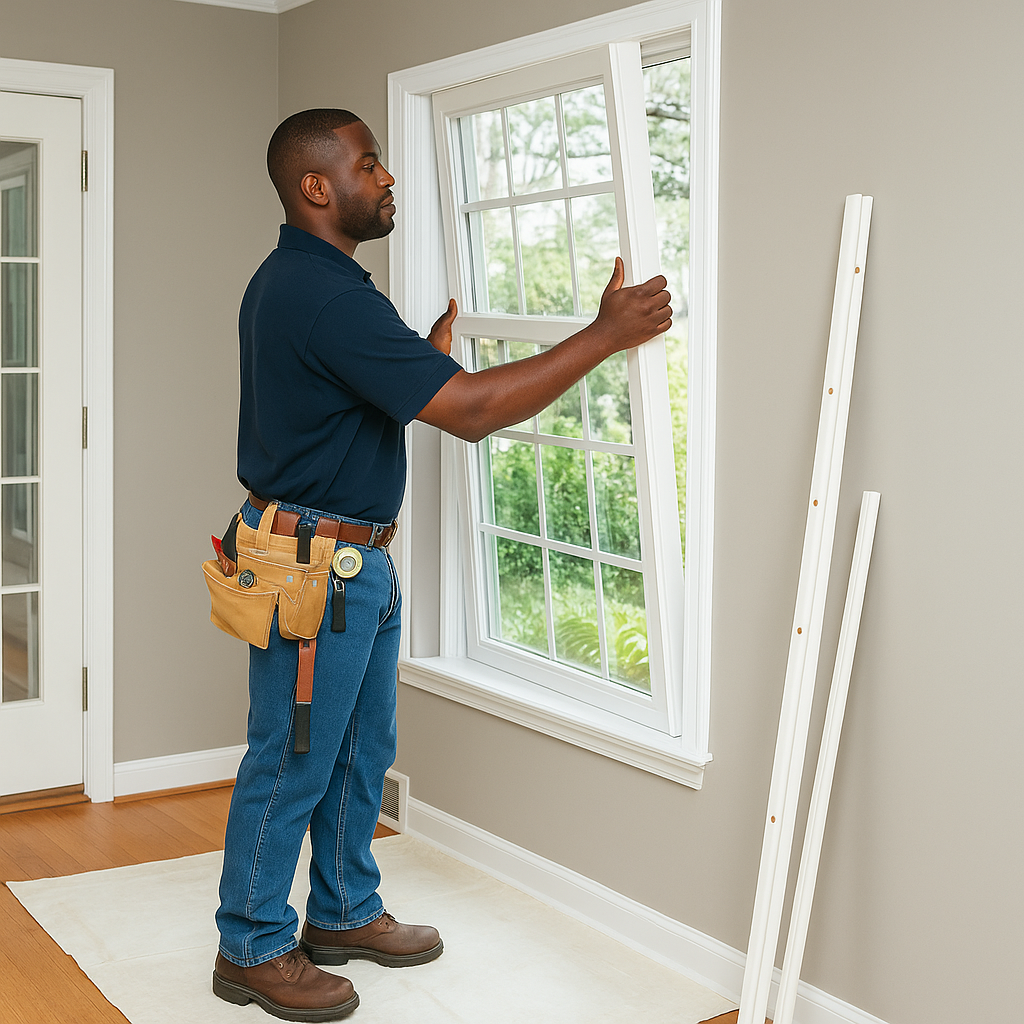
Windows do more work in a home than almost any other single element. They control how much natural light gets in, which determines how bright and spacious rooms feel — genuinely important in Uganda’s naturally bright climate, where a well-lit room barely needs artificial lighting during the day. They manage ventilation and airflow, which matters a great deal in Kampala’s warm, humid conditions where cross-breeze is often the main way a room stays comfortable without air conditioning. They’re the main interface between the inside of a home and the security concern that shapes every buyer’s and tenant’s assessment of a Kampala-area property. And they shape a building’s exterior character and kerb appeal — the first impression a property makes from the road anywhere in Wakiso, Mukono, or Entebbe.
When windows fail — frames rot or corrode, glass hazes or cracks, opening mechanisms seize, seals fail and let moisture in — they fail at all four of these jobs at once. A window that won’t open properly doesn’t ventilate. A window with failed hardware doesn’t secure the room. A window whose frame has deteriorated lets water into the surrounding wall, a real risk given Uganda’s rainy seasons. This guide, drawn from the window installation work we carry out for property owners across Uganda, covers window replacement as an investment: when it’s actually justified, which frame and glazing types suit Uganda’s climate, and what it costs locally.
Looking to build or improve your house or rentals?
We offer home construction and improvement services including building, renovation, painting, tiling, plastering, landscaping, kitchen upgrades, and more.
When Window Replacement Is Justified
Window replacement is a real investment and should be reserved for windows genuinely failing at one or more of their core jobs, not ones that are merely cosmetically tired. The right question for any window on a property in Kampala, Wakiso, or Entebbe is: what is this window failing to do that it should be doing, and is replacement actually the most cost-effective way to fix that?
Replace when: timber frames are actively rotting at the sills, corners, or where they meet the surrounding wall — structural rot can’t be surface-treated and the frame has to come out; aluminium frames have corroded or deformed enough that they no longer open or close properly; opening mechanisms are seized or broken beyond practical repair; or the window specification is genuinely wrong for its position — standard glazing on a ground-floor window in a security-sensitive spot, for example, which is a real concern for many Kampala-area properties.
Repair rather than replace when: the frame is structurally sound but the paint has deteriorated — stripping and repainting is significantly cheaper than replacement and restores the look effectively (see our guide on repainting windows and doors for the full process); hardware — handles, stays, fasteners — has failed, which is a minor, inexpensive fix; or putty or sealant around glass panes has shrunk and cracked, which is a straightforward, low-cost maintenance job.
Window Frame Materials: What Actually Suits Uganda’s Climate
Aluminium frames are the right standard specification for Uganda’s warm, humid climate, and it’s why we recommend them on the great majority of window jobs we take on across Kampala, Wakiso, and Mukono. Aluminium doesn’t rot, doesn’t swell or contract with moisture the way timber does, needs no periodic repainting, and holds its shape and smooth operation for decades. A quality aluminium-framed window installed today will still be fully functional in thirty years with nothing beyond occasional cleaning and hardware lubrication. The upfront cost is higher than timber, but the lifetime maintenance cost is considerably lower — a real advantage for rental properties across Kampala and Wakiso where scheduled maintenance is genuinely hard to guarantee, and for any property exposed to Uganda’s humidity and rainy seasons.
Timber frames have a warmth and character aluminium can’t fully match, and remain appropriate for premium properties across areas like Muyenga, Kololo, and Lubowa where the architectural style calls for real timber elements. The periodic painting and sealant maintenance they need makes them a higher-upkeep choice than aluminium, and their vulnerability to moisture and rot in Uganda’s humid, rain-heavy climate means their service life without active maintenance is notably shorter here than it would be in a drier climate. For most Ugandan properties, aluminium remains the more durable and cost-effective long-term choice.
uPVC frames, widely used in temperate European markets for their thermal insulation, are rarely used in Uganda and not widely stocked locally — the thermal-insulation advantage matters far less in a climate that doesn’t need to keep heat in, and long-term UV resistance under Uganda’s intense equatorial sun is a bigger concern for the material than it would be in a cooler climate. Aluminium remains the practical choice for the Ugandan market.
Looking to build or improve your house or rentals?
We offer home construction and improvement services including building, renovation, painting, tiling, plastering, landscaping, kitchen upgrades, and more.
Glazing and Window Types Common in Uganda
Single glazing is the standard specification across Kampala, Wakiso, Mukono, and Entebbe, and for good reason — thermal insulation is far less of a concern in Uganda’s warm climate than in a cold one, and the extra cost of double glazing rarely pays for itself through energy savings here. Single-glazed aluminium windows are the appropriate, cost-effective choice for the great majority of residential properties in Uganda.
Louvre (jalousie) windows — adjustable horizontal glass slats that tilt open — are extremely common across Kampala and Uganda more broadly, and for good reason: they give excellent, fully adjustable ventilation, are relatively affordable, and suit Uganda’s warm climate better than a fixed-opening casement in many rooms, particularly kitchens, bathrooms, and stairwells. Their main drawback is security — the individual glass slats offer less resistance to forced entry than a solid casement or sliding window, so they’re best used in upper-floor or less security-sensitive positions rather than ground-floor rooms facing the street or compound boundary.
Double glazing gives meaningful thermal benefit in cold climates and useful sound insulation anywhere road or aircraft noise is a real concern. The cost premium over single glazing is significant, and in Uganda it’s rarely justified outside a specific noise problem — for example, a property near a busy stretch of Entebbe Road or close to Entebbe International Airport’s flight path — where the acoustic benefit is worth the extra cost.
Laminated or toughened security glass suits ground-floor windows on properties across Kampala, Wakiso, and Entebbe where physical security is a real priority. Standard glass breaks easily under impact; laminated glass holds together even once broken, which significantly slows down a forced-entry attempt and typically puts off the attempt entirely — a genuine, worthwhile upgrade for ground-floor windows in a security-conscious market.
Looking to build or improve your house or rentals?
We offer home construction and improvement services including building, renovation, painting, tiling, plastering, landscaping, kitchen upgrades, and more.
What Window Replacement Costs in Uganda
- Standard aluminium single-glazed casement window (small, roughly 600x900mm), supply and fit: $60–$120
- Standard aluminium single-glazed sliding window (roughly 1200x900mm), supply and fit: $90–$180
- Larger aluminium sliding window or louvre configuration, supply and fit: $150–$300
- Double-glazed aluminium window, supply and fit: add roughly 40–70% to the single-glazed equivalent
- Security-laminated glass upgrade: add $20–$50 per window to the standard glazing cost
Actual cost still depends on window size, exact frame profile, and glazing specification, and varies somewhat between suppliers across Kampala, Wakiso, and Entebbe.
Getting Window Installation Done Right
Window assessment, frame removal, new frame supply and installation, sealing, and finishing are all part of the work we carry out for property owners across Kampala, Wakiso, Mukono, and Entebbe, and further afield in Jinja, Mbarara, Mbale, Gulu, and Masaka. We supply aluminium-framed windows in a range of configurations and sizes, including louvre options, and advise on the right specification for each window position — security glass where it’s genuinely needed, standard glazing where it isn’t — before anything is purchased. Every installation includes proper sealing at the frame-to-wall junction with the right flexible sealant, since a poorly sealed junction is exactly where Uganda’s rains find their way in.
For a property being prepared for sale or re-letting anywhere in Kampala, Wakiso, or Entebbe, a window assessment before listing identifies exactly which windows genuinely need replacing, which just need repair, and which are already fine — letting a seller target the budget where it actually matters rather than replacing everything on principle.