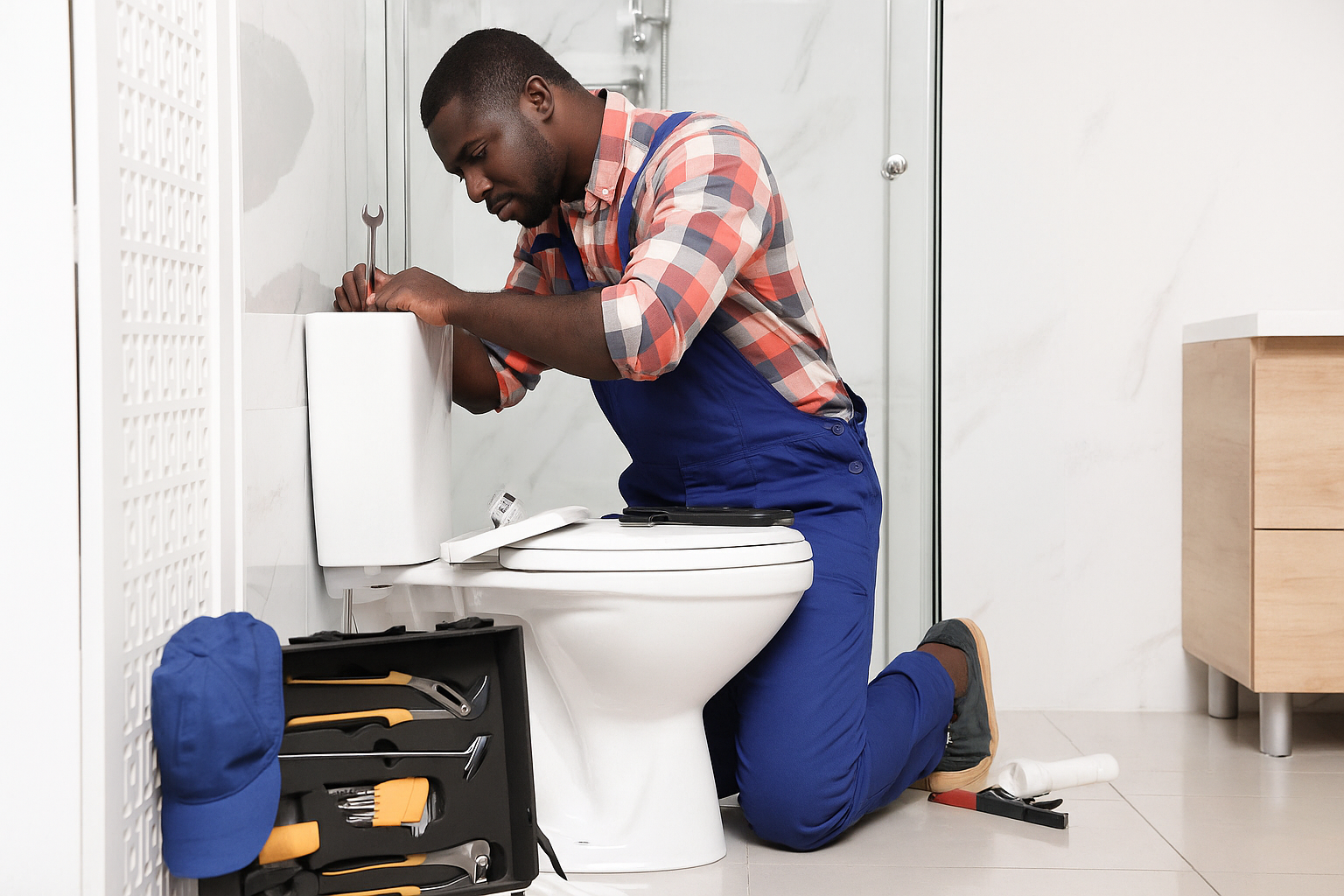
Water efficiency is a genuinely practical financial concern for homeowners and tenants across Kampala, Wakiso, Mukono, and Entebbe — and further out in Jinja, Mbarara, Mbale, Gulu, and Masaka — wherever water is metered, supply is intermittent, or a household tops up with a storage tank, a borehole, or purchased water deliveries that add a per-litre cost on top of the piped supply. That describes a very large share of Ugandan homes. In this context, the toilet is the single largest consumer of household water, accounting for 30–40% of total use. A toilet that flushes 9–13 litres, when a modern equivalent uses 3–6 litres, is wasting 40–60% of the water a household uses just for flushing — waste that shows up directly as a higher water bill, a heavier draw on a storage tank, or a borehole that runs low faster during the dry spells between Uganda’s rainy seasons.
This guide, drawn from the plumbing and sanitary ware work we carry out for property owners across Uganda, looks at low-flow and dual-flush toilet upgrades as a property improvement: the water-saving case, the impact on how buyers and tenants judge a property, what the different upgrade options involve and cost locally, and how toilet condition fits into the wider bathroom picture.
Looking to build or improve your house or rentals?
We offer home construction and improvement services including building, renovation, painting, tiling, plastering, landscaping, kitchen upgrades, and more.
The Water Efficiency Case: Why Toilets Matter More Than Any Other Fixture
Of every water-consuming fixture in a Ugandan home, the toilet has by far the greatest room for efficiency improvement — it accounts for a disproportionate share of total household water use, and the fix (a dual-flush cistern) is mature, cheap, and widely available at hardware shops across Kampala, Wakiso, and beyond.
A standard single-flush cistern common in older Kampala-area homes typically uses 9–13 litres per flush. A modern dual-flush cistern gives a short flush of around 3 litres for liquid waste and a full flush of around 6 litres for solid waste. For a household of four flushing an average of five times a day per person, with roughly 60% short flushes and 40% full flushes in typical use, a 9-litre single-flush cistern uses around 180 litres a day in flushing alone. The same household on a dual-flush cistern uses roughly 84 litres a day — a saving of about 96 litres a day, or nearly 2,900 litres a month.
On a metered water bill, that saving is measurable every month. For a household drawing from a borehole or storage tank, the reduced draw stretches the supply further during the dry stretches between rainy seasons, cutting the risk of running short and having to top up with a purchased water delivery. Purchased water in Uganda typically costs several times more per litre than piped supply, so a household relying on it sees the biggest proportional saving from cutting flush volume.
How Toilet Condition Shapes Buyer and Tenant Perception in Kampala’s Market
Beyond the water saving, toilet condition has an immediate, visible effect on how a buyer or tenant judges a property during a viewing anywhere in Kampala, Wakiso, or Entebbe. The bathroom is the room prospective buyers and tenants inspect most closely, and within it, the toilet is the single element that most directly signals whether the seller or landlord actually maintains the property.
A clean, modern dual-flush toilet with an intact cistern, a decent seat, and fittings in good condition creates an immediate positive impression. An old single-flush toilet with a running cistern audible throughout the viewing, a cracked or stained seat, corroded fittings, and limescale on the bowl creates an equally immediate negative one — and it’s genuinely hard for any other part of the property to overcome that first impression.
The running toilet deserves particular mention. A cistern that keeps trickling water into the bowl after a flush, because the fill valve or flapper has failed, is one of the most common maintenance failures we see in rental properties across Kampala, and one of the most damaging to a landlord’s reputation during a viewing. It’s audible from the bathroom and often from the next room too, and it tells a prospective tenant, unambiguously, that nobody has properly inspected this property in a while. That impression, once formed, colours everything else the tenant sees.
For mid-market properties and above across Kyanja, Ntinda, Kisaasi, and Entebbe Road, a properly functioning dual-flush toilet is a baseline expectation now, not a premium feature. A property priced at competitive mid-market rent or sale value with an outdated, poorly maintained single-flush toilet is sending a mixed signal that buyers and tenants notice — and will use as grounds for a lower offer or a rent concession.
Looking to build or improve your house or rentals?
We offer home construction and improvement services including building, renovation, painting, tiling, plastering, landscaping, kitchen upgrades, and more.
What a Toilet Upgrade Involves and Costs in Uganda
Toilet upgrades range from a small, cheap fix to a full replacement. The right level depends on the existing toilet’s condition, the property’s market position, and exactly what’s wrong with it.
Seat replacement only. For a toilet that’s functionally sound — the cistern fills and empties properly, the bowl is clean, the fittings are fine — but has a cracked, stained, or broken seat, replacing just the seat is the right call. A quality soft-close seat typically costs $8–$18 supplied and fitted in the Kampala market, widely available at hardware shops around Nakasero. Soft-close is worth the small extra cost on a rental property — the slam of a standard seat is a common source of complaint in apartment blocks with shared walls, and the mechanism holds up better under the rougher use rental fittings take. This is arguably the highest-return bathroom micro-improvement available: the visual lift on an otherwise decent toilet is immediate.
Cistern replacement or repair. When the toilet pan itself is fine but the cistern is failing — running continuously, filling slowly, leaking at the base, or simply old and inefficient — replacing just the cistern gets the full efficiency and functional improvement without the cost and mess of removing the pan. A dual-flush cistern, supplied and installed with the right fittings and connections, typically costs $35–$70 in the Kampala area. This single change upgrades a single-flush toilet to dual-flush, stops the water waste from a running cistern, and visually modernises the whole installation.
Full toilet replacement. When the pan itself is cracked, stained beyond a proper clean, visibly out of step with the property’s market position, or the whole installation has simply reached the end of its life, full replacement — pan, cistern, seat, and connecting pipework — is the right approach. A decent mid-quality complete toilet set (close-coupled, dual-flush, soft-close seat) typically costs $40–$90 supplied and fitted for a standard specification, widely available through Kampala hardware shops. Premium options — concealed cisterns (which need a small wall box but give a cleaner look) or wall-hung toilets (easier floor cleaning, a more modern feel) — cost $150–$350 installed and suit upper-market properties where tenants or buyers expect that level of finish, such as units in Muyenga, Bugolobi, Kololo, or Lubowa.
Connecting pipework and supply valve. Any toilet replacement should include checking, and where needed replacing, the water supply valve and the pipework feeding it — these are frequently corroded or only partly working in older Kampala-area installations. A new toilet fitted onto failed pipework will show the same filling and flow problems the old one had. Replacing the valve and pipework typically adds $10–$25 and makes sure the new installation actually works properly from day one.
Looking to build or improve your house or rentals?
We offer home construction and improvement services including building, renovation, painting, tiling, plastering, landscaping, kitchen upgrades, and more.
Dual-Flush Technology: How It Works
Modern dual-flush cisterns use a valve-based mechanism rather than the traditional single-flush siphon that needs priming with a lever. A push-button or two-button actuator on top of the cistern triggers the flush — the short-flush button releases roughly 3 litres, the full-flush button roughly 6 litres, with some variation between brands sold in Uganda.
The push-button design is also more intuitive for users of any age, and having two buttons means the short flush becomes the default most people reach for simply because it’s the more natural option — not because they’re consciously trying to save water. That everyday habit, more than any deliberate conservation effort, is what generates most of the saving dual-flush technology delivers.
The Wider Bathroom Picture
A toilet upgrade delivers its strongest return as part of a coordinated bathroom refresh that deals with every visible and functional issue in the room at once. A new, modern toilet in a bathroom with mould-embedded grout, cracked floor tiles, a dripping shower fitting, and no ventilation is still a bathroom in poor overall shape — the new toilet is a genuine positive, but it can’t outweigh everything else that’s wrong with the room.
For the full framework on bathroom renovation as a rental income strategy across Kampala, Wakiso, Mukono, and Entebbe, see our guide on bathroom renovation for rental income. For the tile side specifically, our post on tile cleaning and regrouting covers how to fix grout condition cheaply when full tile replacement isn’t needed.
Getting Plumbing and Sanitary Ware Work Done Right
Toilet installation and replacement, cistern repair and replacement, shower fitting installation, and full bathroom plumbing are all work we carry out regularly for property owners across Kampala, Wakiso, Mukono, and Entebbe, and further afield in Jinja, Mbarara, Mbale, Gulu, and Masaka. We supply sanitary ware across the full range of quality levels and talk through the right specification for a property’s market position before anything is bought, and every job is completed by a qualified plumber with proper pressure and flow testing before we call it done.
A running toilet, a cracked seat, or an outdated single-flush cistern are among the easiest things for a buyer to spot during a viewing, and among the easiest to use as grounds for a price reduction — fixing them before listing typically costs a fraction of the concession they’d otherwise generate.
Explore Our Properties Across Uganda
Here is our current inventory of land, homes, and rentals in Kampala and across Uganda:
One response to “Installing Low-Flow Toilets Increases Home Value in Uganda”
[…] full pricing on toilet and cistern upgrades specifically, see our guide on low-flow and dual-flush toilets. As a general reference, a dual-flush cistern typically costs $35–$70 supplied and fitted, a […]